Today kicks off Book Expo America at the Javitts Center in New York City. BEA is the largest book convention in the country, though this year is smaller than others.
This year's vibe, I'm told, is going to be somewhere between "we're effed" and "where do we go from here?" Interesting discussions will hopefully happen and break ground for new business models in publishing.
You can follow the chatter on Twitter by watching the #BEA09 hashtag.
Showing posts with label TJ. Show all posts
Showing posts with label TJ. Show all posts
Thursday, May 28, 2009


Thursday, May 14, 2009
Teh Internetz: Browsers and Jewelry

I'm hoping that 98% of y'all won't need me to tell you this, but I'll do it anyway: STOP. USING. INTERNET EXPLORER.
OK, so the latest version of IE isn't too bad, and as far as customization goes, Microsoft's browser of choice is greatly improved from its past versions, but still. All the cool kids are using Firefox. Don't you want to be using what all the cool kids are using?
There are tons of browser options out there: IE, Chrome, Opera, Safari. But Firefox will always be my baby because of its amazing range of add-ons.
Add-ons are kind of like accessories in Final Fantasy games. Ribbons protect you from status ailments, sprint shoes help you move faster, that sort of thing. If you aren't using add-ons for Firefox, you're seriously missing out on the best you could have.
Here are some of my favorite add-ons:
Adblock Plus will get rid of all annoying ads. If you feel frisky, get the Add-Art bundle that replaces all ads with modern art.
SearchStatus will give you the Google Page Rank and Alexa Rank of every page you visit so you can tell what's an awesome site and what's lame.
There are tons of Twitter clients but I like TwitterFox for its simple, out-of-the-way appearance in my Firefox toolbar. It also makes retweeting and sharing a breeze.
HYPERWORDS. Seriously, download it now. Hyperwords allows you to highlight any text on a web page and, with a simple right click, open up a world of possibilities. Instantly Google, Wiki, share via all types of social media, translate, or compare prices. You can instantly Google Map an address, you can price compare a brand of camera, you can find out what the Russian word for "love" is. It has seriously changed my life.
Just like there's an iPhone app for everything, there is a Firefox extension for everything. I'm sure there are a billion awesome ones that I'm missing. Let us know in the comments if I passed on your do-or-die add-on.
Thursday, April 30, 2009
Teh Internetz: Bloggity Blog Blog
Writing on Teh Internetz. We all do it. You may not want to call it blogging, but whatever.
Today, I bring you profiles of some of the more ubiquitous blogging tools. You know. In case you wanna get in on some of that easy blogging money!
(Caveat: There is actually no easy blogging money.)
Speaking of, these are all free services. Unless you want to get fancy, you can run a blog on these platforms for no money at all.
1. Blogger
Blogger is the blogging platform that's owned by Google. You know it; you're looking at it right now. It's Fringe's platform of choice, and it's fairly easy peasy. If you've got a Google account (also known as a Gmail account, though it does more than Gmail, people), then you can log in to Blogger.com and get started right now. However, there's not a ton of room for fancy personalization.
2. Wordpress
A favorite among the slightly tech-savvy, Wordpress sports a clean, streamlined look that can be calibrated to your personal tastes with lots and lots of options. It started life as an open-source blogging service at Wordpress.org, but now it's got the balls of corporate backing. A favorite in my line of work because it's got some great content management systems.
3. Typepad
To my young eyes, it seems as if Typepad has been around since time began. It was one of the first blogging platforms, and it's grown a lot. Typepad is owned by the company Six Apart, which you may know as the creators of Movable Type, another of the early blogging tools. It's actually not too different from Wordpress, but in terms of branding, Typepad has always felt like...an old person's blogging platform. Something almost business-like, I mean.
4. LiveJournal
LiveJournal, or LJ, is a blogging platform used mostly by suicidal teenagers and fans of Twilight. LJ is NOT classy. It's NOT pretty. It's NOT simple to customize. And it's certainly not a blog URL you'd want printed on your Big Girl business cards. But LiveJournal is good at community building, and if you want to bitch about TV shows and hot vampires, this is the place to do it.
I can say all these horrible things about LiveJournal because I use it. In fact, I use all these different services for different blogging projects. Depending on what you want your blog to be about and how much effort you want to put in its maintenance, you can decide for yourself.
Today, I bring you profiles of some of the more ubiquitous blogging tools. You know. In case you wanna get in on some of that easy blogging money!
(Caveat: There is actually no easy blogging money.)
Speaking of, these are all free services. Unless you want to get fancy, you can run a blog on these platforms for no money at all.
1. Blogger
Blogger is the blogging platform that's owned by Google. You know it; you're looking at it right now. It's Fringe's platform of choice, and it's fairly easy peasy. If you've got a Google account (also known as a Gmail account, though it does more than Gmail, people), then you can log in to Blogger.com and get started right now. However, there's not a ton of room for fancy personalization.
2. Wordpress
A favorite among the slightly tech-savvy, Wordpress sports a clean, streamlined look that can be calibrated to your personal tastes with lots and lots of options. It started life as an open-source blogging service at Wordpress.org, but now it's got the balls of corporate backing. A favorite in my line of work because it's got some great content management systems.
3. Typepad
To my young eyes, it seems as if Typepad has been around since time began. It was one of the first blogging platforms, and it's grown a lot. Typepad is owned by the company Six Apart, which you may know as the creators of Movable Type, another of the early blogging tools. It's actually not too different from Wordpress, but in terms of branding, Typepad has always felt like...an old person's blogging platform. Something almost business-like, I mean.
4. LiveJournal
LiveJournal, or LJ, is a blogging platform used mostly by suicidal teenagers and fans of Twilight. LJ is NOT classy. It's NOT pretty. It's NOT simple to customize. And it's certainly not a blog URL you'd want printed on your Big Girl business cards. But LiveJournal is good at community building, and if you want to bitch about TV shows and hot vampires, this is the place to do it.
I can say all these horrible things about LiveJournal because I use it. In fact, I use all these different services for different blogging projects. Depending on what you want your blog to be about and how much effort you want to put in its maintenance, you can decide for yourself.
Thursday, April 16, 2009
Teh Internetz: National Poetry Month
As you should all know by now, we're smack-dab in the middle of National Poetry Month. Oh, poets! You will never make any money.
But don't worry, poor prisoners of verse. There are ways to celebrate digitally.
DailyLit, a service that will e-mail you books in manageable installments or provide them on your RSS feed, is offering free bite-sized chunks of poetry throughout April. Their Masters of Verse collection is a nice way to remind yourself of all those stanzas you had to memorize in high school. And it will give you a chance to LOL at the title choice of Good-By and Keep Cold by Robert Frost (because everyone knows the original title was STAY FROSTY).
If you're struggling to write your poetry but can't concentrate because your roommate's new girlfriend squeals like a pig and the walls in your apartment are paper-thin (for example), maybe you need a distraction-free text editor like WriteMonkey. I'm pretty sure Byron used something very similar.
And hey, do you remember the slightly scammy old Poetry.com? Well, now it's been bought by Lulu.com, the Print-On-Demand (POD) company, and they will apparently give poets money sometimes.
So April is totally not the cruelest month. I mean, it's no cakewalk, but it's certainly not the worst. So suck it up, Eliot.
But don't worry, poor prisoners of verse. There are ways to celebrate digitally.
DailyLit, a service that will e-mail you books in manageable installments or provide them on your RSS feed, is offering free bite-sized chunks of poetry throughout April. Their Masters of Verse collection is a nice way to remind yourself of all those stanzas you had to memorize in high school. And it will give you a chance to LOL at the title choice of Good-By and Keep Cold by Robert Frost (because everyone knows the original title was STAY FROSTY).
If you're struggling to write your poetry but can't concentrate because your roommate's new girlfriend squeals like a pig and the walls in your apartment are paper-thin (for example), maybe you need a distraction-free text editor like WriteMonkey. I'm pretty sure Byron used something very similar.
And hey, do you remember the slightly scammy old Poetry.com? Well, now it's been bought by Lulu.com, the Print-On-Demand (POD) company, and they will apparently give poets money sometimes.
So April is totally not the cruelest month. I mean, it's no cakewalk, but it's certainly not the worst. So suck it up, Eliot.
Monday, April 6, 2009
Teh Internetz: Pride and Prejudice and Zombies
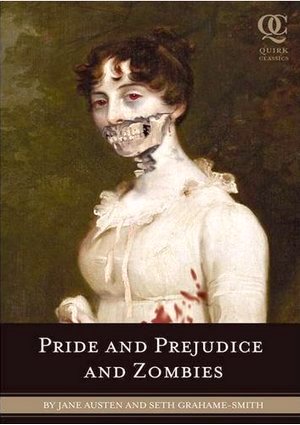
I don't often do book reviews for Fringe. I leave that to my colleagues who are down with the learnin'. But guys, as a hardcore interweb nerd, I cannot help but force my bookish opinions on you when it comes to Quirk Books' Pride and Prejudice and Zombies. If you've been living under a non-nerd rock, then maybe you haven't heard how awesome it is. The original text by Jane Austen is melded with added scenes and twists from Seth Grahame-Smith, who I am now stalking on Twitter (@sethgs).
What you might call an exercise in ridiculous pop culture trend-huffing is probably the best book ever made. Let me repeat that: THIS IS THE BEST BOOK EVER MADE.
The book itself is pretty self-explanatory. I will leave other, more powerful bloggers to tell you what the reading experience is like. (Here's a hint: it's awesome, and also, there are ninjas.)
Fans of Jane Austen might balk at an old, beloved story being turned into mindless entertainment complete with explosions and Kill Bill-esque swordfights. But those fans can go to hell. You had your chance, Austen fans. You took the original story and turned it into a thousand and one incredibly boring movies with an unending stream of women with big hair playing Elizabeth and chiseled-jawed dudes playing Darcy. For the last few hundred years, we've done it your way. Now it's time to do it our way.
"Our way" is the internet's way, of course. One of the longest standing rules of the online world is that anything plus zombies is bound to be better. (Ninjas help too.)
Why do you think, months before this book even pubbed, geeks were already frothing at the mouth? Because we knew it couldn't lose.
Everything that makes Pride & Prejudice is still intact. The delicate play of relationships, the unspoken code of honor that doesn't seem to exist in our time, the pomp and circumstance of high society: it's all still there. But it's been augmented just a tad. The zombie threat does something magical here. Not only does it serve to help us through the duller scenes (I thought that ball would NEVER end!) but it steps in to inform the characterization. What had previously been merely Elizabeth's dry wit and keen intelligence is now fashioned into a killing machine. What was originally Darcy's aloofness and haughtiness is now the burden of a lone samurai warrior. These aren't parodies of Austen's characters; they have only grown to strange new heights.
The real brilliance is that the story begins well after the zombie threat has emerged, which gives our heroes ample time to adjust to life amid the undead. Being trained to kill zombies is the norm, and life can continue on despite the frequent attacks. So the original plot has plenty of space to develop with just a sprinkling of crazy violence throughout.
And, oh, did I mention there are ninjas?
Look, you're going to want to buy this book. The hope is that Quirk Books continues in this vein with other classic novels remixed with a little zombie. Can you imagine A Tale of Two Cities...and Zombies"? "It was the best of times, it was the worst of times, and oh wait, did I mention the zombies!?"
Tuesday, March 24, 2009
Teh Internetz: Ada Lovelace Day

Hello, Fringe-philes. Today I bring you a bit of blogging with heart and soul, for today is Ada Lovelace Day, a day to commemorate the achievements of ladies in the field of computing, engineering, innovation, and general awesomeness.
Ladies holla!
I love making ladies holla, so I jumped on the Ada Lovelace Lovefest ship at the first toot of its smokestack horn. But then I realized, holy crap, I don't know any awesome lady computing superstars! Except for myself. And I think this day is supposed to be used to recognize ladies who have invented useful things, not lame YTMND pages.
So I dove headfirst into some Wikipedia research. Yeah, that's right. I didn't go to my local library or scour an old folks' home looking for aging female inventors hungry to share their life stories.
And it doesn't matter that I did this half-assed. Because I learned something. You know Hedy Lamarr? Silver screen starlet during Hollywood's Golden Age? Running gag in many Mel Brooks movies?
Well she was also a scientist, y'all. And she patented frequency-hopping spread spectrum instruments. Do you even know what that is? I SURE DIDN'T.
But without this innovation in the use of radio frequencies, originally intended to help us win the war against the godless Nazis, we wouldn't have the sweet wireless technology we all enjoy today.
So thank you, Hedy Lamarr. You were both extremely attractive and a brainy boffin. It's like one of those sitcoms where a smart gal is all geeky and wearing glasses, but you know that eventually she'll take off her glasses and maybe take her hair out of her library-lady bun and she will turn out to be totally hot.
It's kind of like that. BUT REAL.
Happy Ada Lovelace Day, guys.
Thursday, March 12, 2009
Teh Internetz: Teh Twitter

Twitter.
Twitter, Twitter, Twitter.
What can I tell you about Twitter that hasn't already been said by online news sources, annoyingly persistent traditional media, the drinkers of Haterade, and those in the book marketing biz?
What can I say that is more poignant or true than what Twitterer extrodinarie and all-around role model to the geek Stephen Fry says about Twitter and all social media being a threat to the media as we know it?
What uses of Twitter could I point out that you couldn't easily Google on your own?
Yes, I know. It's the Next Big Thing that all the hipsters are doing, so it sucks. And it seems stupid and useless to most of you, and 140 characters (not words, characters) can't possibly help a human being communicate a successfully nuanced thought. And of course you're angry about what this all means for the future of language.
So I'm going to ignore all that. Because you can argue about all that on Facebook, which, if you recall, lots of people resisted with vigor and stubbornness when it first arrived. But I won't mention that either!
I'm going to tell you a story about the power of Twitter.
It's a cautionary tale, an urban legend that I think holds in its grip a microcosm of the human condition.
For nearly two months, I impersonated an obscure British celebrity on Twitter. Well, impersonate is a strong word. "Fucked around as" is better. You can read the tawdry details here, at a blog I'm writing with some friends who want to chronicle the awesome things we can accomplish. I listed this as an accomplishment because I reached 1,000 followers on Twitter all by just tweeting stupid jokes. I thought that was impressive at the time.
But when I deleted the account two days ago, this was the final tally.

I deleted the account because, at a very simple level, dicking around online with other car enthusiasts and trading stupid jokes wasn't much fun anymore. The fun had been overshadowed by the sinking feeling that no one on Twitter understood that I was a fake, that this was all for laughs. For every @Reply I received saying "Good one, mate" I got ten asking me when my TV show would be back on the air. I tried to explain to those people that I wasn't real, but there were too many of them, and 140 characters is not a lot of space to say "Look at a bio, you twit" without sounding mean.
I eventually had to ignore all those questions or else I'd lose my mind. Then there were people who would bluster around like the worst detective in the world, trying to unmask me, even though the confession was right there if they cared to find it. One man tweeted me to say, "I went to high school with someone who knows the real Clarkson, and if you can tell me this obscure fact about him, I'll know you're not fake."
I replied, "Look, mate, maybe you should read my bio. Here's a link to it, even."
His response? "SO YOU CAN'T ANSWER THE QUESTION, CAN YOU?"
Whoa there, Sherlock. Pace yourself.
Look, I know people are, on the whole, idiots, but that idiocy seems to be multiplied on Twitter, when they're restricted to such a small space to express themselves. In the inverse fashion, brilliant people have their brilliance magnified by exactly the same format. It just goes to show.
At any rate, I came to understand that the people who didn't get it, who weren't bothered to check out simple litmus tests of fact, weren't ignorant of the internet or naive about online exchanges. I couldn't be mad at them for not following directions or taking me at my word. Now I think that they simply didn't want to know the truth, because it was more fulfilling to them to believe that I was really a man that they loved.
But I wasn't. So I ended it. I hadn't set out to deceive or trick; I had wanted to entertain, but now I see there is nothing about the Twitter platform that makes it an ideal vehicle for terribly bad comedy. Twitter should be, I now theorize, about connecting to and sharing things with people who care about the same things. It should be about being real, I guess. In whatever way that makes sense to you.
Use Twitter, or don't use Twitter. The world won't end either way, I'm sure. If you do use it, use it in a way that is representative of you and your work. Connect with people you would want to speak to if you were at the same cocktail party. Try to be nice if you're a nice person; if you're a douche, run free, my friend.
If you don't use Twitter, then that's okay too. But I would tell you not to be afraid of exploring it. There's nothing to be scared of. It's nothing as confusing as the first time you linked to something on a blog, or as difficult as the first time you played Oregon Trail.
Worst comes to worst, you can always delete yourself.
Tiny self-aggrandizing endnote:
You can follow TJ (the real TJ) on Twitter @tjdietderich.
Thursday, February 12, 2009
Teh Internetz: Writing and/or Dying

As I continue to yammer on about how to write and use the internet at the same time and how the internet can help you write instead of edit, I bring you yet another online tool in the constant battle of the Word Count.
Dr. Wicked's Write or Die is a tool that a few of my fellow WriMos used during November. The idea is simple: you type into the Write or Die box, and if you don't, you're cyber-smacked on the backs of your hands in various ways. The worst and most effective way? If your stream of words cease, the application begins deleting what you've written so far.
It's like water-boarding for writers!
Dr. Wicked, the app's creator, says:
This is aimed at anyone who wants to get writing done. It requires only that you recognize your own tendency towards self-sabotage and be willing to do something about it. If you're sick of saccharine writing advice that no one could honestly follow and you want a real method to getting work done.
I agree with this dude completely! I'm done being a pansy writer, sitting around waiting for mah muse. Give it a shot next time you're stuck or on a deadline.
Thursday, January 29, 2009
Writing Under Stress

Several weeks ago, two days before my twenty-fifth birthday, I was struck by a case of appendicitis and had to undergo an emergency appendectomy at Maimonides Medical Center in Brooklyn. I had never been hospitalized before, had never even broken a bone before (though I suffered a nasty sprain resulting from a too-spirited game of Wii Tennis).
Before you get all freakily concerned, I'm fine. Appendectomies are like the bean burrito of surgeries: you can't really mess one up, and the professionals have probably done thousands of them in their careers. Going under the knife (or rather, the tiny little instrument they now use) didn't bother me as much as the fact that everything was taking place, in my mind, in sort of an abstract sense.
I experienced it not as, I think, a normal person should experience an illness. Or maybe it is and I just never had a chance to find out before now. But my mind was stuck seeing things as if I was jotting down mental notes for Chapter Five of a best-selling memoir. I couldn't remember for the life of me what the name of my nurse was or who I had given my insurance card to or where I'd dropped my blood-soaked backpack (an IV needle went badly during admittance). I could only remember really, really good imagery and symbolism, metaphors and morbid jokes.
I recall vividly the old woman, stuck in the ER hallway with me, beating the metal railing of her hospital bed with her red velvet slipper and shouting "I need help! I have a terrible pain!" over and over while everyone ignored her.
I remember drifting off to sleep while waiting for a CAT scan, only to be woken up by an old man vomiting blood into a small blue plastic tupperware at my elbow.
I know for sure that before I went under, the surgeon said to me, "Boston, huh? Just think: if it'd only been a few months earlier, you might be getting this surgery at Harvard. But now you're at Maimonides!" He seemed to think was fantastically bad planning on my part. (It is a testament to the amount of pain I was in, I guess, that I didn't bother to point out the nonexistence of The Harvard Hospital.)
But I can't remember what my last thought was before they snuffed me out, or who was with me when I woke up, or what they had dressed me in and at what point. Important, applicable facts escape me. I was only interested in writing my memoirs.
After a miraculous recovery that I attribute to my relatives force-feeding me bacon and cream-based soups, I can't help but wonder if all the things I'm experiencing in my life are viewed through this delusional lens of Writer. Historian. The Hero of Our Tale. What arrogance is this, that I refuse to remember what plan my health insurance is, but I expect my rendering of a red velvet slipper smacking against metal to somehow be of importance to someone else?
As with most of my existential crises, this one was solved in a homosexual way. I had volunteered with SAGE (Services & Advocacy for GLBT Elders), and they've decided to put me to work on a project, along with tons of fantastic and talented writers, to collect my elders' life stories and write them up in a book. It's an exciting project that could go in many different directions, and it serves to remind me that I am not my own best character. I am not the hero of this memoir (that doesn't exist and probably wouldn't get published if it did). The best characters are the people around me, and I need to be concentrating on their stories.
I guess this post has a moral? I am sorry about that. Here, have a picture of a cute kitten.
Thursday, January 15, 2009
Teh Internetz: Ignoring Online Distractions

Most of my writing friends decry the internet as a huge time-waster when they should be focusing on their writing. But Cory Doctorow of BoingBoing recently wrote a column about how one can write in the age of internet distraction. (By the way, if you have taken my advice and set up a feed reader, you should add BoingBoing, as it is the repository of all that is right and wrong online.)
Here's a little snippet from the column:
The single worst piece of writing advice I ever got was to stay away from the Internet because it would only waste my time and wouldn't help my writing. This advice was wrong creatively, professionally, artistically, and personally, but I know where the writer who doled it out was coming from. Every now and again, when I see a new website, game, or service, I sense the tug of an attention black hole: a time-sink that is just waiting to fill my every discretionary moment with distraction. As a co-parenting new father who writes at least a book per year, half-a-dozen columns a month, ten or more blog posts a day, plus assorted novellas and stories and speeches, I know just how short time can be and how dangerous distraction is.
But the Internet has been very good to me. It's informed my creativity and aesthetics, it's benefited me professionally and personally, and for every moment it steals, it gives back a hundred delights. I'd no sooner give it up than I'd give up fiction or any other pleasurable vice.
It's followed by some pretty decent advice on how to get your writing done by following some simple rules. My personal Achilles heel while writing on my laptop? The bullet point about eschewing research while in the middle of writing. I get distracted so easily by Wikipediaing a fact or looking up a Google Map of a city I'm not terribly familiar with. I think it's my intense, perverted love of hard facts that tempts me so easily from fiction; I am tricked into thinking that the injection of a real fact will somehow help my fiction writing and make it more realistic. In some cases, I wish I had Wikied something before submitting my piece (who knew that India was actually ABOVE the equator?) but the bulk of my experience has been that cleaving to facts has only hampered the creative process.
At any rate, it's not the fault of the internet for distracting you any more than it's MacDonald's fault that you're fat. Just don't eat too many online Big Macs at inappropriate times, and you should be fine.
Thursday, December 4, 2008
Teh Internetz: Lessons from Winning NaNo

As I emerge into a new world where I guess we're going to get a real president and stuff, I can't help but feel nostalgic about my NaNoWriMo experience. As I shared with you weeks and weeks ago, I participated in an online push to write 50,000 words in 30 days. And I did it. Whee, confetti.
This was the first time I had done NaNo, and it was a crazy month. My days were full of hurried writing. I took my new teeny tiny laptop everywhere I went. I wrote in coffee shops, in wine bars, in grocery stores, in Union Square, and on the subway. I wrote during lunch breaks and before work and after work and on the weekends. I wrote lots and lots and lots of stuff.
Maybe 20% of what I wrote is actually usable.
The structure of NaNo is unique because you get so worked up about hitting your word count, you'll write anything. You go from day to day, trying to dig yourself out of the hole you created yesterday when you decided to watch House instead of write. You're throwing in adjectives and adverbs and flashbacks and background information just to stretch the words out. The vast majority of it? Complete crap.
But the point of NaNo isn't to write something fantastic. The point is to get in a safe zone where your creative brain is forced to produce. There is no second-guessing, no self-editing. There is only your fingers and your keyboard and no filter in between. And that is a precious thing to experience.
Imagine what we could write if we weren't worried about writing well. Imagine how freeing it would be to write without the expectation of defending your creative choices to a class of fellow students or a writing group of clove-smoking colleagues. Imagine writing something that came straight from your neural synapses, the primordial ooze of thought. Something proto-fictional. Something raw.
And yeah, okay, chances are it sucks. But for every 2,000 words of suck, there might be a glimmer, a phrase, a sentence of pure, unadulterated genius that you would have never arrived at unless you'd gone through this concentration camp approach to writing.
I may not have a great novel right now, but I do have a 50,019-word framework from which to fine tune my great novel. And that sure as heck beats writing nothing for years and years. So maybe NaNo isn't for you. But maybe locking yourself away and just forcing it to come might be the way to go for some of us.
Thursday, November 20, 2008
Teh Internetz (But Not Really): Recycling Someone Else's Blog Post
As I said before, I am deep in the trenches of writing a novel in 30 days or less, or the whole book is free. So this post comes to you from the sort-of distant past. I write this one day before the election, so I am still beautifully in the dark. I can still worry about silly things.
Like grammar.
My nerd and language hero, Stephen Fry, has just written a new blog post about the nature of language which is a must-read for any writer. Especially writers who (whom? no, no, I think it's okay) are freaking out about vomiting up a minimum word count every day, regardless of whether it's grammatically correct or even makes any sense.
It's a beautiful argument against Language Nazism, and a lovely mantra to keep in mind as you attempt to break through your block to get words down on the processor. Here's a snippet:
It does, sir. It does.
Like grammar.
My nerd and language hero, Stephen Fry, has just written a new blog post about the nature of language which is a must-read for any writer. Especially writers who (whom? no, no, I think it's okay) are freaking out about vomiting up a minimum word count every day, regardless of whether it's grammatically correct or even makes any sense.
It's a beautiful argument against Language Nazism, and a lovely mantra to keep in mind as you attempt to break through your block to get words down on the processor. Here's a snippet:
Sadly, desperately sadly, the only people who seem to bother with language in public today bother with it in quite the wrong way. They write letters to broadcasters and newspapers in which they are rude and haughty about other people’s usage and in which they show off their own superior ‘knowledge’ of how language should be. I hate that, and I particularly hate the fact that so many of these pedants assume that I’m on their side. When asked to join in a “let’s persuade this supermarket chain to get rid of their ‘five items or less’ sign” I never join in. Yes, I am aware of the technical distinction between ‘less’ and ‘fewer’, and between ‘uninterested’ and ‘disinterested’ and ‘infer’ and ‘imply’, but none of these are of importance to me. ‘None of these are of importance,’ I wrote there, you’ll notice – the old pedantic me would have insisted on “none of them is of importance”. Well I’m glad to say I’ve outgrown that silly approach to language. Oscar Wilde, and there have been few greater and more complete lords of language in the past thousand years, once included with a manuscript he was delivering to his publishers a compliment slip in which he had scribbled the injunction: “I’ll leave you to tidy up the woulds and shoulds, wills and shalls, thats and whiches &c.” Which gives us all encouragement to feel less guilty, don’t you think?
It does, sir. It does.
Thursday, November 6, 2008
Teh Internetz: Teeny Tiny Laptops

This post and my next post were written far in advance and set to post automatically. As I shared last time, I am deep in the throes of NaNoWriMo and cannot be bothered by things like blogging and eating.
So as I write to you from the distant past of October 29th, when we still don't know if the election is going to have a "hiccup" or not, if Palin will suddenly grow bat wings and attack elite gay socialists, or if the war in Iraq will ever stop, I bring a sense of charming naivety.
Today I will discuss very small laptops, because I just bought one and I sort of want to gloat about it? In order to maximize my on-the-go writing time, I decided to invest in an ACUS eee PC. Mine is green, like the one pictured, weighs 2 lbs., and runs on Linux. For the ungeeky, Linux is an open-source computing platform. It's like Windows except free and crowd-created and moderated. It doesn't do everything that Windows or a Mac could do, but it is pretty nifty. And since I'll just be using this as my ultraportable, I don't need it to do much besides connect to the internet and type.
But for those writers that need more OOMPH from their mobile writing gadgets, here are some options:
The ultra-thin, ultra-sexy Mac Book Air is pretty, but lacks the usefulness you'd like in your amazingly expensive Apple product.
Looking slightly less hot but a better marriage prospect is the Fujitsu Lifebook.
The Lenovo ThinkPad line consistently gets good reviews on everything from endurance to memory to battery life.
But if you need something cheaper, take a look at what's available in Under $600 Land.
Thursday, October 30, 2008
Teh Internetz: NaNoWriMo

This year, for the first time, I will be doing NaNoWriMo. For the uninitiated, that stands for National Novel Writing Month. This year will be its 10th anniversary.
The point of NaNoWriMo is to create an online support system that challenges participants to write a 50,000 word novel in the 30 days of November. It's a grueling task that only a small percentage of participants complete, but apparently it's supposed to give you the same feeling of accomplishment as running a marathon.
Just...you know...with words instead of actual steps.
Though I've never tried doing NaNoWriMo before, here are some tips that I've been told might help when attempting to write a novel in a month. They might end up being good general writing mantras.
- 1. Do not edit or censor as you type. Just barf those words onto the word processor.
2. Make a calendar with specific word count goals for each day.
3. Create an outline to work from so you stay focused.
5. Use NaNoWriMo.org to meet up with other NaNos in your area to bitch, mainline coffee, and participate in write-ins.
The point of writing a novel in 30 days isn't to write anything GREAT, it's just to write freely with the support of a community of writers. Good luck to any fellow NaNos out there; let's look forward to December.
Thursday, October 16, 2008
Teh Internetz: Password Protection

A few weeks ago, I nerd-laughed (which is a sort of phlegmy, halting snicker) at Sarah Palin for having her Yahoo account hacked as well as Bill O'Reilly for having his web site hacked.
Stupid, un-web savvy n00bs, I chortled. God, who uses yahoo e-mail anymore anyway?
Then, a few days later, I got totally hax0red.
A personal blog I had kept since I was 15, chronicling my every teenage honey-nut angst-morsel and drama-ridden spinach-puff, was hacked and wiped clean of all information. Sure, it wasn't as horrifying as, say, compromising government business or releasing personal contact information of hundreds of paid subscribers, but it still sucked big time. Luckily, I had a content backup system and I was able to contain the damage, but that is no excuse. I should have had a better password protection system in place.
As writers, you will hopefully be keeping digital archives of your work along with important e-mails from your (god willing) agent and/or publisher. Consider this a friendly reminder to stop using "password" as your password.
Lifehacker has a great article here about how to keep your password safe.
Bottom line:
- 1. Don't answer your security questions in a clear-cut fashion; obscure the answers.
2. Choose passwords that are complex.
3. Use a password manager to keep track of them.
So go ahead. Change that password you've been using for 10 years. It might be annoying, but it'll make you safer in the long run.
Thursday, October 2, 2008
Teh Internetz: Feed Readers

If you're a writer...
No, scratch that, if you are ANYONE living in the world today, you must start using an RSS feed reader if you haven't already. In a nutshell, a feed reader will take the content from a web site (usually when you click on the nifty orange button with the radio waves in your toolbar) and FEED that content into an interface that is controlled by you. Feed readers enable you to view, organize, share, tag, and keep tabs on your favorite sites without checking each one every single day. It will change the way you browse, certainly. But do not be afraid.
Most people, my stubborn past self included, don't like the idea of switching to a reader for their online needs. They whine: "Oh, but I like visiting my sites! I like seeing them for myself! I like wasting time and being inefficient for hours and hours on end."
Fine. Suit yourself. But the rest of us fly honeys are going to be rocking our readers.
For writers, a reader can help you keep track of your favorite author blogs, organize news feeds, and stay on top of sites that are helping you research that next great American novel (and I say that without snark or incredibly dull patronization). For publishing folks, it can help you follow industry news and financial stuff. And here's something awesome: you can even set up feeds from job sites so you can easily scan the help wanted sections for your chosen profession. It's how I landed my gig.
And of course, there are the blogs. Millions and millions of blogs. The internet is just teeming with them. And you can follow them all, from cooking to cakes to LOLcats, on a reader.
If you want to set up an RSS feed reader for yourself, you have a lot of options. Here is a list of the top 5 as compiled by Life Hacker. I personally use Google Reader, which, if you have a Google Account, is already ready and waiting for you.
They should all take only a few minutes to set up. Then the fun begins: adding your feeds. Start right now. Click the little orange button up there. Yeah, that one in the address bar if you're using Firefox. Probably lower in the toolbar if you're using IE (we'll talk about that later). Who knows where the hell it might be on Opera. Chrome? It's probably already thought ahead for you. Anyway, give it a click. Add the Fringe blog to your reader. You'll be glad you did.
Thursday, September 18, 2008
Teh Internetz: social booking networks
Hello writers and other assorted lovers of the written word,
You may look at the heading of my humble blog post and say, "Internet! P'towie!" ("P'towie" being the sound cartoon characters make when they spit; if you can actually spit while making this noise, please record it and e-mail it to me. I would be most delighted.)
Anyway. I understand your spitting anger.
The internet represents to many of us the fast-paced tide of time, a death march whose tempo is meted out by that annoying hamster song, a flurry of hyperlinks and hyperactivity. This new future we find ourselves in appears to be devoid of art, love, beauty, and most distressingly, well-written novels published to deserving nationwide acclaim. Children don't read anymore, you might cry. No one cares about books, you might groan. They only care about cats with captions and the myriad ways failure can be captured on camera and then blogged about.
To you I say: don't despair, Negative Nancy. The internet is content, and content is your product! Writers and teh series of tubes go together like lions and the circus (minus the cruel abuse in most cases).
I may be biased because I'm an online/interactive book marketer (which is a fancy way of saying: a synapse between the nerves of publishers, authors, and bloggers) but I truly believe that books and the internet are the greatest technological advances of their respective ages, and they can help each other in ways that we haven't quite gotten around to dreaming up yet.
But we're already on the right track! So my tiny contribution to this blog will be regular updates on the online world and how it can help inform your writing, your career, your understanding of the publishing industry, and your life's general betterment.
No need to thank me. It's my job.
So as a gentle way of guiding you into the online book world, please feel free to dip your cautious toes into the following pools. These are social networking sites, like Facebook and MySpace, but for books and book lovers. Many of these sites allow authors to create special profiles and connect to their readers. Check them out.
Good Reads
LibraryThing
Shelfari (Owned by Amazon)
Book Jetty
Anobii
You may look at the heading of my humble blog post and say, "Internet! P'towie!" ("P'towie" being the sound cartoon characters make when they spit; if you can actually spit while making this noise, please record it and e-mail it to me. I would be most delighted.)
Anyway. I understand your spitting anger.
The internet represents to many of us the fast-paced tide of time, a death march whose tempo is meted out by that annoying hamster song, a flurry of hyperlinks and hyperactivity. This new future we find ourselves in appears to be devoid of art, love, beauty, and most distressingly, well-written novels published to deserving nationwide acclaim. Children don't read anymore, you might cry. No one cares about books, you might groan. They only care about cats with captions and the myriad ways failure can be captured on camera and then blogged about.
To you I say: don't despair, Negative Nancy. The internet is content, and content is your product! Writers and teh series of tubes go together like lions and the circus (minus the cruel abuse in most cases).
I may be biased because I'm an online/interactive book marketer (which is a fancy way of saying: a synapse between the nerves of publishers, authors, and bloggers) but I truly believe that books and the internet are the greatest technological advances of their respective ages, and they can help each other in ways that we haven't quite gotten around to dreaming up yet.
But we're already on the right track! So my tiny contribution to this blog will be regular updates on the online world and how it can help inform your writing, your career, your understanding of the publishing industry, and your life's general betterment.
No need to thank me. It's my job.
So as a gentle way of guiding you into the online book world, please feel free to dip your cautious toes into the following pools. These are social networking sites, like Facebook and MySpace, but for books and book lovers. Many of these sites allow authors to create special profiles and connect to their readers. Check them out.
Good Reads
LibraryThing
Shelfari (Owned by Amazon)
Book Jetty
Anobii
Subscribe to:
Posts (Atom)