Showing posts with label Elizabeth. Show all posts

Friday, November 7, 2008

Online Poetry: Observe, Remember, Imagine

Writers should keep their senses open at all times, remember what those sense receive (even and especially when that information is not fully understood), and when in the process of writing they find they have forgotten something, they should make up resplendent lies, details more real than the real. A vague bluff will always be called. Ravi Shankar's Pike Place in Studio Vol. 2, Issue 1. Unfortunately, it does so not by demonstrating the results of such actions but by illustrating the sort of lackluster verse that appears in its absence.

Frankly, if Pike Place Market weren't such a major tourist attraction, I would assume that he had never been there and had, at best, read that horrible corporate motivation book the fish throwers released. The trouble begins in the first stanza with the lines "Puget Sound sounds astound / no one for the crowd is pressed." The poet needs to describe those sounds for them to be meaningful; if he wanted to dodge that responsibility, he should have called them ocean or sea sounds, since the use of a name instead implies something unique about it. The pun on Sound does not ameliorate this. Had he managed a truly remarkable description, I might have been willing to forgive him for not realizing that, no matter the behavior of the crowd, the Sound would have to be unusually loud for anyone in the market to hear it given the ambient noise of the city and the distance from the water.
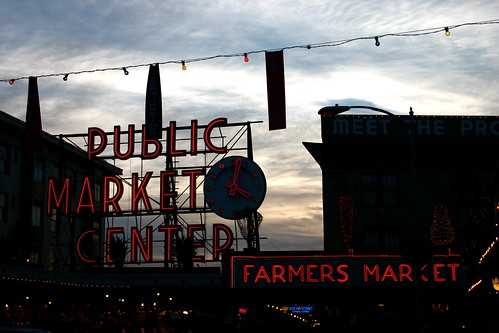
From here, Shankar goes on to describe the "fishmongers" in cliché terms as "sinewy" and "young". Even their movements are non-individualized. They cut the fish "with an efficiency of motion". He says they give out "coral nubs of salmon / jerky", though even this vegetarian knows there's a huge difference between hard (let alone coral hard), dry jerky and soft fresh fish. He accuses them of "wisecracking the entire time" but gives the reader none of their words. He tells the reader that they are "minor stars in their own minds." The prepositional phrase implies that they are puffed up, though certainly the "rapt" crowd Shankar has described should support their own estimation. It further suggests that the speaker, not specifically differentiated from the poet, considers himself superior to, or at least more clear-sighted than, these men.

The next two stanzas read as exposition lifted from some book describing "Seattle’s oldest market" Shankar conscientiously lists specific "edibles / . . . treated like art objects" but fails to give any life to these descriptions.

Then the poem jumps into what I assume Shankar believes is the most important part: the description of what happened to Japanese-Americans who owned fish stalls when they were forced into internment during World War II. Unfortunately, this too remains vague. We get the title of the order that led to their incarceration but not the names of the people themselves. Had Shankar earlier given better details, remembered or imagined, of the present-day market, he might be able to connect them much more smoothly and powerfully to the stories of Japanese-Americans (even if he had to make up a family and research the names on baby-name websites) instead of using, for a transition, the line "I wonder how many remember", which oozes with smug superiority.

After that, he gives descriptions of shoppers and ferry boats which carry a fair bit of detail. I suspect, given their place in the structure, that they were supposed to resonate ironically with the words about the internment of Japanese-Americans. As there were no real details to hold onto in those words, however, these later lines fall flat.

Finally, he ends with what has to be the oddest line in the whole poem: "I haven’t seen a single Asian all day." Has this man ever been to Seattle? Had he just been hanging out in Packwood all day before driving in to visit Pike Place? The lie is almost big enough that if it had come at the end of a strong poem, it might have had a formidable effect—that of a metaphor or remembrance of history getting in the way of seeing reality. At the end of a vague weak poem, however, it feels like the last thrash of a drowning victim.

This shows how even a potentially powerful idea cannot thrive unless the poet pays attention and remembers or is willing to risk a dramatic, detailed lie. I did not write this to pick on Shankar. For all I know, this poem may represent a rare lapse on the part of a highly skilled poet. We all write bad poems. I've thrown away more poems in a single year than most of you reading this will compose in a lifetime. I wrote this criticism because I want people to see how damaging failure to observe and remember or imagine precisely and without fear can be.

Tuesday, October 28, 2008

Right There by Melissa Mann

The short lines and repeated sentence structures of Melissa Mann's Right There give the poem the frantic feel of an insomniac mind; it reads like the 4 AM poem that the note preceding it identifies it as being. Characteristic of sleepless thought, too, is the way the poem builds from minor kitchen accidents to relationships to social inequality then draws them all together again. At first the conclusions drawn from what is focused upon seem exaggerated, the products of a mind that sleep because it is overwrought:

You see this burn on my arm?

Right there

Is why you should never

Cook.


Slowly, they come to make more sense. Avoiding a dent in the wall (and presumably a minor injury on the part of whoever hit into it) is probably worth restraining one's urge to tell one's partner

To open

The sodding

Tin of beans

Herself.


Even the flattened characters who appear near the end fit into the insomniac mindset: the "hedge fund manager", the "single mum" become like the shadows outside the insomniac's window, incompletely known yet able to fuel the speaker's racing thoughts.

Nonetheless, the lines about

that disabled woman

On the tube

Having to ask someone

To give up their seat


are problematic because people with disabilities often suffer from people seeing them only as disabled. Here the speaker not only echoes this unfortunate tendency but goes on to use the woman to prove her a point that frankly has nothing to do with the woman but is, rather, an appropriation of her identity and situation. (Besides, the fact that not all disabilities are visible or make someone need a seat on the subway seems entirely overlooked.) Similarly, the "single mum in Rotherham" is nothing more than a geographical location and a single mother whose home has been repossessed. Why is she a single mother? Why is she in such a desperate position?

The answers don't seem to matter for this poem; they show the limits of the speaker. "It's all right there"— even the reasons why the speaker cannot go beyond fantasies of dropping out of society and being loved to work to improve "the steaming pile of shit" and to fix her relationship.

Less redeemable is the verse about the heart wrapped in muslin. The confusion of cause and effect (one should hide one's heart away so as to avoid hiding one's heart away), while reflective of insomniac thought, slows the poem's pace. More importantly, specifying that the material hiding and protecting the heart is muslin does little to relieve the cliché.

Tuesday, October 14, 2008

Four Landscapes by Jerome Rothenberg

Each of Jerome Rothenberg's Four Landscapes on PFS Post suggests a different way in which a landscape and the lives within it may be viewed as one travels through "on a train".

In the first, descriptive lines alternate with statements that destroy, contradict, or interrogate them. It's not quite Adorno or Hegel but something beyond between them. Figures crossing a bridge are revealed to (possibly) be more than just picturesque figures witnessed but, rather, being for whom this might be a daily or weekly journey. The everyday occurrence of crossing the street is made strange. What bells mark changes because everyone who hears them will have a different take. An arm is closed with another arm. This shifting resembles the way one's perception of a landscape shifts as one travels through it. The framing created by the full end stops resembles the frame of the train's window which creates the possibility of perceiving a series of connected, static scenes cut-off from the world like camera shots.

In the second landscape, the speaker picks out various details and moments. Their eyes dart from sky to hand to house. Any total picture must be put together in their mind after this sense data has been gathered, just as the reader must use these short, full end-stopped lines to put together a whole poem and a whole image (if they wish to do so).

The third focuses in on one detail, then moves to another one, related but still cut off by a full stop. The last line, more abstract, represents a return in thought to the original detail.

The fourth landscape moves in a similar way, only two related details follow the one focused upon. Moreover, the stampeding horses and the fire are the sorts of things that distract, that dramatically grasp at one's attention, so the overall effect is less tranquil and contemplative.

Monday, September 29, 2008

Zachary Kluckman's "Exodus By Mass Transit"

Something unsettles me about Zachary Kluckman's "Exodus By Mass Transit", the first poem in Orgami Condom's recently completed eleventh issue. It begins with a description of a woman on a bus, the driver in fact, and, due to my experiences as a transit-dependent poet, it is easy for me to imagine the poet (or narrator) sitting on the bus scribbling down these details. With that beginning, when the poem moves into expressions of her thoughts and experience, it feels as though the speaker appropriates the woman's identity--makes her image his puppet--in order to get his ideas across. Phrases like "the cancer of cigarette glamour" drip with judgment; the narrator evaluates the woman he sees on the basis of what he imagines about her. He even manages to use her to embody abstractions: "It’s never about the stories, only the need to tell them." Not surprisingly, the stories she would wish to tell do not get told: only the poet's do.

This is, of course, what writers do: we see and reimagine. We are not seeking precise facts and truth. We may take the way you hold your head and make it mean the opposite of what it means to you. We choose which stories we tell.

What this poem does when the words of the author meet my personal experience is to create a reminder of the need for humility in the writer, especially when we write about subjects who may have less social or economic privilege than we do. To be or act otherwise risks using language in the service of an imperial gaze.

Tuesday, September 16, 2008

Mark DeCarteret's Feasts/Week 17

The seven poems of Mark DeCarteret's recent Beard of Bees chapbook, Feasts/Week 17, take saints' names so that each represents a different feast day, as if the short collection were a week out of church calendar with brief, 3-line explications of each day's saint. Strict adherence to a 5-7-5 haiku structure leads to a degree of condensation that, together with sparsity of punctuation, makes these verses function less as explanations than as objects for consideration and meditation. Uncovering the meanings of the lines and their relationships to the saints of their titles (whether legitimate Catholic saints or otherwise) requires conscious acts of interpretation by readers. They must consider these poems as the devout consider the mysteries of the rosary.

Take the first poem, for instance: "st george". The majority of educated anglophone readers have likely heard of this dragonslayer and so, assuming they can make the leap from dragon to serpent, should feel some sense of connection between the first line and the title. The serpent, however, is not killed. In fact, an act of interpretation is required to determine whether anything at all is done to the serpent. Is "sound" a verb (as parallelism suggests) or a noun (the more common usage)? Are the three lines a series of instructions or a description of actions accomplished (or being accomplished) being told via an atypical verb tense?

In creating these objects for contemplation, DeCarteret repeats certain themes. Medical imagery--"lip's herpes", "aspirin-white", "anesthetized type"--appears in the first three poems. Then there are the twists on cliches: "this world’s last gasp", "unsigned dotted line", "...or else". Unfortunately, in the italicized lines of "st peter mary chanel" there's a little too much cliche and not enough twist. Despite the cleverness of the title, the verse itself seems dull.

One of the greatest dangers of writing in such a short form is that, no matter how dense the writing, the reader may reach the end and feel as if they have read nothing substantial. Challenges to interpretation such as this chapbook presents are one way to overcome this, one way to slow the reader down. Such a technique also requires that the poems raise the desire in the reader to linger over the poems. The aforementioned "st peter mary chanel" fails for me in this regard; the other poems succeed to varying degrees with a smattering of onomatopoeic lines being the most powerful in this regard. Such judgments, of course, are necessarily subjective. Do these poems draw you in?