Seattle has a new independent book store, tucked away in a second floor story of a shopping plaza off Broadway and specializing in poetry and small press releases. Pilot Books doesn't sell all the latest bestsellers, and it probably won't change that anytime soon. If you're looking for chapbooks, local zines or small press novels you'll be well suited to stop by. The store is open 12-8 every day except Wednesday.
The owner, Summer, is a friendly and knowledgeable book lover with a rockin tattoo of mastadons on her arms. "I’m always saying Pilot Books is for the now, the new, authors writing and publishing in times such as these," writes Summer on the bookstore's blog.
Don't fear that you'll have a hard time browsing just because you don't see the latest Dave Eggers or Jhumpa Lahiri. Handmade signs bearing slogans like "new" and "local artist" stick out of books. I'm sure Summer would be happy to discuss any of the titles in detail with you.
The tiny upstairs features a lending library and armchairs. According to the Pilot Books blog, Summer's planning on hosting weekly themed writing workshops and possibly reading groups in the future, too. During my visit the store was crowded with curious shopper and well-wishers, and was getting ready to welcome its first reading later that week. Not bad for a shop that had been open three weeks.
Pilot claims to be Seattle's Most Secretive bookstore. If you're in the area give it a shout-out and maybe we can change that reputation.
Showing posts with label poetry. Show all posts
Showing posts with label poetry. Show all posts
Wednesday, June 24, 2009


Wednesday, June 10, 2009
Open Book: Jorie Graham on Balancing Parenthood and Poetry
I'm a fan of Slate V's Open Book: Writer's on Writing—a collaboration between Slate and the NYU Creative Writing Program. Check out their most recent video interview of Jorie Graham in “Balancing Parenthood and Poetry.” I love the image of Graham rubbing her pregnant belly on Emily Dickinson's grave!
Sunday, April 19, 2009
A few of my favorite things
One comment to my April 1st post ushering in National Poetry Month suggested that I tell you my favorite places to read poetry online. These are just a few of the many places I like to browse when I am searching for a new poem to write or want to read something besides what's on my shelves.
Mannequin Envy is a site that I enjoy as much for the poetry as for the carefully selected images that accompany the texts. The poems on the first read might seem "off the cuff," but they aren't messy first drafts. As I reader I feel that these poems hit the unexpected, get dazed, and keep going in order to do it again.
H_ngm_n: A Journal of Online Poetry and Poetics is fun to navigate, and the layout feels fresh. They publish a handful of poems and longer poems by the poets so you get a good sense of each individual voice. This poetry seems to need to be read aloud, preferably in the company of an improvisational jazz band in the background; it makes me feel like I need a cigarette and I don't even smoke.
There's no need for me to say anything about what Ploughshares offers in poetic quality since so many established writers have been published there, but what you may not know is that the web editions of each issue rotate which texts are available. So if the Duhamel poem is locked today, next week it might not be.
No Tell Motel updates with a new poem almost every day, and they usually publish several poems by each poet so sometimes I find someone I like and start looking for other things they've written that are available on the web. The styles and subjects are really varied, so if the first poem isn't to your liking, just keep scrolling down for something different.
And lastly, I adore The Dead Mule School of Southern Literature. Each writer has a Southern Legitimacy Statement,but they are mostly not Jeff Foxworthy rip-offs. The poetry and fiction are well-crafted contemporary pieces with dashes of regionalism, identity, and place.
So tell me what are your favorite places to read poetry (or any other genre) online?
Thursday, April 16, 2009
Teh Internetz: National Poetry Month
As you should all know by now, we're smack-dab in the middle of National Poetry Month. Oh, poets! You will never make any money.
But don't worry, poor prisoners of verse. There are ways to celebrate digitally.
DailyLit, a service that will e-mail you books in manageable installments or provide them on your RSS feed, is offering free bite-sized chunks of poetry throughout April. Their Masters of Verse collection is a nice way to remind yourself of all those stanzas you had to memorize in high school. And it will give you a chance to LOL at the title choice of Good-By and Keep Cold by Robert Frost (because everyone knows the original title was STAY FROSTY).
If you're struggling to write your poetry but can't concentrate because your roommate's new girlfriend squeals like a pig and the walls in your apartment are paper-thin (for example), maybe you need a distraction-free text editor like WriteMonkey. I'm pretty sure Byron used something very similar.
And hey, do you remember the slightly scammy old Poetry.com? Well, now it's been bought by Lulu.com, the Print-On-Demand (POD) company, and they will apparently give poets money sometimes.
So April is totally not the cruelest month. I mean, it's no cakewalk, but it's certainly not the worst. So suck it up, Eliot.
Friday, April 10, 2009
Fringe contributors: 2008 Best of the Net finalists
We're happy to announce that two Fringe contributors were finalists for the 2008 Best of the Net anthology: Jehanne Dubrow, for her "Fragment from a Nonexistent Yiddish Poet" number 22, and Pattabi Seshadri, for his poem "Chairs." Two of Jehanne's poems, which appeared originally in the excellent Mezzo Cammin, were chosen for the anthology. This year's guest judge for poetry was Dorianne Laux.
You can read #22 and three more of Jehanne's poems in Fringe issue 13. Pattabi's "Chairs" plus two more poems appear in Fringe issue 11.
Best of the Net, put out by Sundress Publications, gathers fabulous fiction and poetry from online litmags and puts it all in one spot. Each year. Since 2006. Props to Erin Elizabeth Smith, managing editor and poetry coordinator. Keep it up, Sundress! And congrats to Jehanne and Pattabi.
Thursday, April 9, 2009
Fringe Contributors Rock: Poetry Edition

Here's the third of a series of semi-regular posts that will showcase the fine work of Fringe contributors past. Today we look at the loads of poetry that our former contributors have tossed onto the internet
- Alaskan Bridge to Nowhere poet BRAD JOHNSON has work up in Pank, Insolent Rudder, Clapboard House, the Kennesaw Review and Facets.
- COREY MESLER has a funky new chapbook out that's available on Etsy and at his own bookstore.
- HESTER MURMAN was our second featured artist, but now she's publishing poetry under her real name -- Gindy Elizabeth Houston, over at The Smoking Poet
- Artist PETER SCHWARTZ has also turned poet with pieces in Diagram, Cella's Round Trip, Frostwriting and Poetry Super Highway.
Wednesday, April 1, 2009
Happy National Poetry Month!
NaPoWriMo has arrived! April is National Poetry Month, and Read Write Poem is celebrating with a thirty poems in thirty days challenge. Here's my angle: write all the poems on a theme and have a draft for a chapbook. Yes, some days I might miss a poem, and on other days everything I write might frankly stink. That's what good friends and revision are for. But that won't be the case every day, and getting a few gems out of NaPoWriMo will be worth joining this big alliterative orgy of clever slant rhymes, puns, hypertexts, wit, and sharp social criticism.
An excellent place to look for inspiration is Poets.org's Poem A Day e-mail list, which is also archived on the website. I could list my favorite online places to read poems, but I think it's more fun to find your own. Start with the great work on Fringe and start following links. I always arrive to something cool, most recently Hit and Run Magazine.
Still not fired up? Read Charles Bernstein's satirical Against National Poetry Month. He's right perhaps about what the aim of the corporate sponsorship of NaPoMo is about, but that's no reason to ignore perfectly good free poems a day, and if you're inspired to write anti-poems sometimes, that's good, too.
Friday, March 27, 2009
poems for public radio
WMUK, Kalamazoo's NPR affiliate, put out an unusual request recently:
"Local public radio station wants to feature poems about radio experiences of any kind and/or fundraising to be read by area poets during the final day of pledge drive, April 4, in the afternoon. Station streams on internet so you can hear your poem. If you have anything, please mail to [mme642-at-yahoo.com] WMUK (Kalamazoo, Michigan) is the station. Humor good. Sentiment good. No cussin'."
via newpages
How's that for originality and support of literature?
Now if I can just get my NPR-lovin friends together to help me compose an ode to Ira Glass.
Sunday, March 15, 2009
Midnight Bus Poetry
 Over at Slog they're keeping the spirit of poetry alive by publishing bus-related poems written by their faithful readers in a new column called, Midnight Bus Poetry. Check out posts by Paul Constant for poems—which may not be highbrow but certainly are highly amusing!—about the bus riding experience. And if you're inspired, why not submit your own? Poems need to be 50 words or less and should be emailed to poetryonbuses@thestranger.com. Winners appear here and on the Slog Blog. Enjoy!
Friday, February 27, 2009
Poems for the first 100 days
If you are needing a healthy dose of current events, delivered via poetry, you might want to have a look at Starting Today: Poems for the First 100 Days. I am sad to say it has taken me until day 38 of the project (and, ergo, the Obama administration) to post about this. But here's to day 38! And here's to Arielle Greenberg and Rachel Zucker for making the project happen.
All kinds of poets are up there--Major Jackson with some knockout couplets for day 22, Cornelius Eady considering the much-considered inaugural poem for day 14, Diane Wald with a "nonromantic valentine" for day 27. I have also in particular enjoyed days 2 (Matt Rohrer), 3 (Martha Silano), 4 (Aimee Nezhukumatathil), 19 (Laurel Snyder), 20 (Cate Marvin), 23 (Erin Belieu), 26 (Nin Andrews), 32 (Mark Doty), 36 (Lindsey Wallace).
There's a lot of funny bits, and some stuff that is convincingly sincere and moving. And they said that couldn't be done with "political poetry." Well, I have news for they, and the news is actually getting a little old, and it goes something like, "yes we can!"
Sunday, December 28, 2008
Yay for water, nay for whimsy
Behold AQUARIUM: Fuselit's 13th issue of poetry, short fiction, artwork and musical trinkets from amongst the likes of Pomegranate’s Richard O'Brien, Steve Himmer, Chelsea Cargill and Brittle Star’s David Floyd.
So yes, it’s small and cute and oh so pretty, but do its lovingly bubble-painted pages caress innards of satisfying substance? It’s a worthy question, to which the heart warming answer is yes, yes, yes; this is a delightful collection of prose and poetry that also happens to fit neatly in the palm of one’s hand.
As you might hope to expect, the writers offer an impressive and diverse array of bite-sized slithers of word joy, varying from witty and absurd to slyly understated and sneakily sinister. You can but marvel at how this particular rabble of writers has taken the theme and run, rolled, skipped and swam with it. This really is a tiny chest of treasures just waiting to acquaint themselves with your trembling, greedy, grateful fingers.
This issue also comes with an equally dinky CD, as well as a super fun mix and match poetry booklet: the pages are cut into three, allowing the reader to mess up the various stanzas in order to create confections that the editors promise will vary from the ‘alarmingly incongruous’ to those which make ‘unexpected sense’ – and, of course, the best results will often be a heady combination of the two.
Just be sure not to spill coffee on it (or anything sticky/corrosive/stain-inducing, really).
Tuesday, November 18, 2008
The Nobel, the Zeitgeist, and the All-American Poem


Dear Lents, dear 82nd avenue, dear 92nd and Foster,
I am your strange son.
--Matthew Dickman, "Lents District"
When the Nobel Academy's permanent secretary, Horace Engdahl announced that U.S. literature is "too isolated, too insular," he wasn't so far from the truth as we'd like to believe. Sure, Slate Magazine is right to suggest that the Nobel committee has no clue what's going on in American literature—despite its enormous presence, especially among young writers, on the World Wide Web. But even then, what you find in American poetry, at least, as well as its fiction, is the pervasive influence of PoMo theory, self-referential language deconstruction, and the politics of Identity. Some of it is readable, some dull to the point of tears. I often find myself reading this stuff and saying, "So what?"
I recently finished reading Virgil's Aeneid and found it a kind of hack-job of Homer, nothing new in the world of criticism, but I found it out for myself. What is important is that I arrived at this conclusion only after a careful examination of Virgil's forebears—Homer, Sophocles, Aristotle, and the rest of the Greeks—as well as his fellow Romans—Horace, Ovid, et al. Thus, I've learned for myself that the only way to approach literature is through a careful refinement of the sensibility, through being informed of the entire history of literature. Taste is something different, but even within its confines I realize that Virgil is important, but he doesn't suit me.
It is in this state of mind that I recently attended Portland's literary festival, Wordstock, solely to hear Matthew Dickman read from his APR-winning first book, All-American Poem. Dickman has all the elements of the current American zeitgeist: the humor, the French-styled imaginative flourishes, the stream-of-consciousness machine-gunning of images building and building upon one trope or another. Just look at his poems on the Boston Review.
But whereas other contemporary young poets offer detailed maps of their imagination, or contemplate their undependable self and voice, Dickman charges into his poems with an inherent sense of both hope and the human condition, as well as the desire to communicate. Rather than relying on self-referential feelings, Dickman looks outward to the neighborhoods he grew up in, to the people in his life who have suffered, and in this way he resembles Whitman. Still, he does look inward, but to his own faults, cruelties, and blindsides. Even in this self-regard, he rises above it to offer a vision, a kind of unity, no matter how unstable, and he's careful enough to say, as he says in the poem "Trouble", "I want to be good to myself."
The Nobel committee knows nothing about a poet like Dickman, of course. As Marvin Bell has said to students, "I don't care about the poems you're writing now, I care about the poems you'll be writing ten years from now." As Dickman says in his poem, "V": "maybe this is not a giant leap / into the science of compassion, but it's something." And so, it is exciting to think where Dickman will take this all, his sweeping themes, his adherence to tradition. If we're lucky, we may see a writer like Dickman wearing a ribbon in fifty years, rising as all good cream does to the top, singing the "all-American, broken in half and beautiful."
Friday, November 7, 2008
Online Poetry: Observe, Remember, Imagine
Writers should keep their senses open at all times, remember what those sense receive (even and especially when that information is not fully understood), and when in the process of writing they find they have forgotten something, they should make up resplendent lies, details more real than the real. A vague bluff will always be called. Ravi Shankar's Pike Place in Studio Vol. 2, Issue 1. Unfortunately, it does so not by demonstrating the results of such actions but by illustrating the sort of lackluster verse that appears in its absence.
Frankly, if Pike Place Market weren't such a major tourist attraction, I would assume that he had never been there and had, at best, read that horrible corporate motivation book the fish throwers released. The trouble begins in the first stanza with the lines "Puget Sound sounds astound / no one for the crowd is pressed." The poet needs to describe those sounds for them to be meaningful; if he wanted to dodge that responsibility, he should have called them ocean or sea sounds, since the use of a name instead implies something unique about it. The pun on Sound does not ameliorate this. Had he managed a truly remarkable description, I might have been willing to forgive him for not realizing that, no matter the behavior of the crowd, the Sound would have to be unusually loud for anyone in the market to hear it given the ambient noise of the city and the distance from the water.
 From here, Shankar goes on to describe the "fishmongers" in cliché terms as "sinewy" and "young". Even their movements are non-individualized. They cut the fish "with an efficiency of motion". He says they give out "coral nubs of salmon / jerky", though even this vegetarian knows there's a huge difference between hard (let alone coral hard), dry jerky and soft fresh fish. He accuses them of "wisecracking the entire time" but gives the reader none of their words. He tells the reader that they are "minor stars in their own minds." The prepositional phrase implies that they are puffed up, though certainly the "rapt" crowd Shankar has described should support their own estimation. It further suggests that the speaker, not specifically differentiated from the poet, considers himself superior to, or at least more clear-sighted than, these men.
The next two stanzas read as exposition lifted from some book describing "Seattle’s oldest market" Shankar conscientiously lists specific "edibles / . . . treated like art objects" but fails to give any life to these descriptions.
Then the poem jumps into what I assume Shankar believes is the most important part: the description of what happened to Japanese-Americans who owned fish stalls when they were forced into internment during World War II. Unfortunately, this too remains vague. We get the title of the order that led to their incarceration but not the names of the people themselves. Had Shankar earlier given better details, remembered or imagined, of the present-day market, he might be able to connect them much more smoothly and powerfully to the stories of Japanese-Americans (even if he had to make up a family and research the names on baby-name websites) instead of using, for a transition, the line "I wonder how many remember", which oozes with smug superiority.
After that, he gives descriptions of shoppers and ferry boats which carry a fair bit of detail. I suspect, given their place in the structure, that they were supposed to resonate ironically with the words about the internment of Japanese-Americans. As there were no real details to hold onto in those words, however, these later lines fall flat.
Finally, he ends with what has to be the oddest line in the whole poem: "I haven’t seen a single Asian all day." Has this man ever been to Seattle? Had he just been hanging out in Packwood all day before driving in to visit Pike Place? The lie is almost big enough that if it had come at the end of a strong poem, it might have had a formidable effect—that of a metaphor or remembrance of history getting in the way of seeing reality. At the end of a vague weak poem, however, it feels like the last thrash of a drowning victim.
This shows how even a potentially powerful idea cannot thrive unless the poet pays attention and remembers or is willing to risk a dramatic, detailed lie. I did not write this to pick on Shankar. For all I know, this poem may represent a rare lapse on the part of a highly skilled poet. We all write bad poems. I've thrown away more poems in a single year than most of you reading this will compose in a lifetime. I wrote this criticism because I want people to see how damaging failure to observe and remember or imagine precisely and without fear can be.
Frankly, if Pike Place Market weren't such a major tourist attraction, I would assume that he had never been there and had, at best, read that horrible corporate motivation book the fish throwers released. The trouble begins in the first stanza with the lines "Puget Sound sounds astound / no one for the crowd is pressed." The poet needs to describe those sounds for them to be meaningful; if he wanted to dodge that responsibility, he should have called them ocean or sea sounds, since the use of a name instead implies something unique about it. The pun on Sound does not ameliorate this. Had he managed a truly remarkable description, I might have been willing to forgive him for not realizing that, no matter the behavior of the crowd, the Sound would have to be unusually loud for anyone in the market to hear it given the ambient noise of the city and the distance from the water.
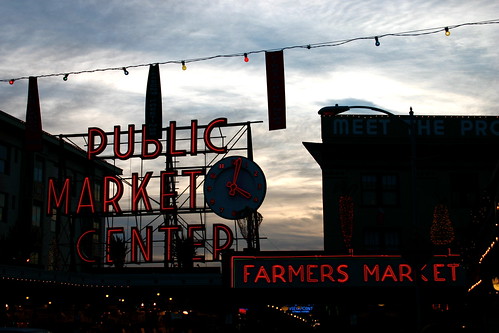 From here, Shankar goes on to describe the "fishmongers" in cliché terms as "sinewy" and "young". Even their movements are non-individualized. They cut the fish "with an efficiency of motion". He says they give out "coral nubs of salmon / jerky", though even this vegetarian knows there's a huge difference between hard (let alone coral hard), dry jerky and soft fresh fish. He accuses them of "wisecracking the entire time" but gives the reader none of their words. He tells the reader that they are "minor stars in their own minds." The prepositional phrase implies that they are puffed up, though certainly the "rapt" crowd Shankar has described should support their own estimation. It further suggests that the speaker, not specifically differentiated from the poet, considers himself superior to, or at least more clear-sighted than, these men.
The next two stanzas read as exposition lifted from some book describing "Seattle’s oldest market" Shankar conscientiously lists specific "edibles / . . . treated like art objects" but fails to give any life to these descriptions.
Then the poem jumps into what I assume Shankar believes is the most important part: the description of what happened to Japanese-Americans who owned fish stalls when they were forced into internment during World War II. Unfortunately, this too remains vague. We get the title of the order that led to their incarceration but not the names of the people themselves. Had Shankar earlier given better details, remembered or imagined, of the present-day market, he might be able to connect them much more smoothly and powerfully to the stories of Japanese-Americans (even if he had to make up a family and research the names on baby-name websites) instead of using, for a transition, the line "I wonder how many remember", which oozes with smug superiority.
After that, he gives descriptions of shoppers and ferry boats which carry a fair bit of detail. I suspect, given their place in the structure, that they were supposed to resonate ironically with the words about the internment of Japanese-Americans. As there were no real details to hold onto in those words, however, these later lines fall flat.
Finally, he ends with what has to be the oddest line in the whole poem: "I haven’t seen a single Asian all day." Has this man ever been to Seattle? Had he just been hanging out in Packwood all day before driving in to visit Pike Place? The lie is almost big enough that if it had come at the end of a strong poem, it might have had a formidable effect—that of a metaphor or remembrance of history getting in the way of seeing reality. At the end of a vague weak poem, however, it feels like the last thrash of a drowning victim.
This shows how even a potentially powerful idea cannot thrive unless the poet pays attention and remembers or is willing to risk a dramatic, detailed lie. I did not write this to pick on Shankar. For all I know, this poem may represent a rare lapse on the part of a highly skilled poet. We all write bad poems. I've thrown away more poems in a single year than most of you reading this will compose in a lifetime. I wrote this criticism because I want people to see how damaging failure to observe and remember or imagine precisely and without fear can be.
Monday, November 3, 2008
The Relevance of Rexroth

Walking in Greenwich Village a few years ago, I saw a small historical plaque affixed to the building where Dylan Thomas died, having drank himself into oblivion. What was one poet's reaction? The poem "Thou Shalt Not Kill".
Has anything changed? Today Brooklyn, home to Whitman, is a bastion for writers. Denver, too, is home to writers and the magazines that promote them; no longer does it bear Ginsberg’s “Denver Doldrums.”
Chicago, too, is experiencing a renaissance--at least if one can measure it via the poets circulating through, orbiting poets like Joshua Marie Wilkinson whose Rabbit Light Movies film many of these poets passing through. Aside from Poetry magazine and Carl Sandberg, even beyond the Chicago Review and other presses, who knows the literary history of Chicago?
Read An Autobiographical Novel, a stunning text by Kenneth Rexroth and an invaluable document of the era just before the Depression in Chicago. Rexroth writes about the urban Midwest with so much detail, with such panache, it’s been said his book will make your own life seem morbidly dull.
In its heyday, Chicago was home to anarchists, communists, agitators, artists, and writers. Rexroth throws around names no one would recognize today. Sure, he lived in New York, too, and beneath Hart Crane’s apartment no less, where young “Rex” could hear Crane playing his blues records while writing White Buildings. But Chicago! Who would have known how much had happened there in theater, in painting, and in the response of labor movement crowds to poems read on street corners and soapboxes?
Jacket Magazine features a tribute issue to Rexroth, including an essay by Sam Hamill, a excellent introduction to a profound influence on an entire generation of poets, especially “the Beats” whom he had little patience for. Rexroth’s influence in San Francisco is what we generally attribute to him, especially acting as MC for the Six Gallery Reading, and also for his “basement readings” with Lawrence Ferlinghetti.
Aside from a recent issue of Chicago Review devoted to him, and the release of his collected poems by Copper Canyon Press (edited by Hamill and Bradford Morrow), and even a website, the Bureau of Public Secrets, featuring generous portions of his work, is his legacy somewhat neglected? Perhaps not.
Having read nearly all of his books—which include not only poems but his magnanimous essays—I’d like to suggest a return to a deeper study of his formidable intellect, his model of the life well-lived, his astounding recollections of American history, and the deep and compassionate understanding of the human condition.
Tuesday, October 28, 2008
Right There by Melissa Mann
The short lines and repeated sentence structures of Melissa Mann's Right There give the poem the frantic feel of an insomniac mind; it reads like the 4 AM poem that the note preceding it identifies it as being. Characteristic of sleepless thought, too, is the way the poem builds from minor kitchen accidents to relationships to social inequality then draws them all together again. At first the conclusions drawn from what is focused upon seem exaggerated, the products of a mind that sleep because it is overwrought:
Slowly, they come to make more sense. Avoiding a dent in the wall (and presumably a minor injury on the part of whoever hit into it) is probably worth restraining one's urge to tell one's partner
Even the flattened characters who appear near the end fit into the insomniac mindset: the "hedge fund manager", the "single mum" become like the shadows outside the insomniac's window, incompletely known yet able to fuel the speaker's racing thoughts.
Nonetheless, the lines about
are problematic because people with disabilities often suffer from people seeing them only as disabled. Here the speaker not only echoes this unfortunate tendency but goes on to use the woman to prove her a point that frankly has nothing to do with the woman but is, rather, an appropriation of her identity and situation. (Besides, the fact that not all disabilities are visible or make someone need a seat on the subway seems entirely overlooked.) Similarly, the "single mum in Rotherham" is nothing more than a geographical location and a single mother whose home has been repossessed. Why is she a single mother? Why is she in such a desperate position?
The answers don't seem to matter for this poem; they show the limits of the speaker. "It's all right there"— even the reasons why the speaker cannot go beyond fantasies of dropping out of society and being loved to work to improve "the steaming pile of shit" and to fix her relationship.
Less redeemable is the verse about the heart wrapped in muslin. The confusion of cause and effect (one should hide one's heart away so as to avoid hiding one's heart away), while reflective of insomniac thought, slows the poem's pace. More importantly, specifying that the material hiding and protecting the heart is muslin does little to relieve the cliché.
You see this burn on my arm?
Right there
Is why you should never
Cook.
Slowly, they come to make more sense. Avoiding a dent in the wall (and presumably a minor injury on the part of whoever hit into it) is probably worth restraining one's urge to tell one's partner
To open
The sodding
Tin of beans
Herself.
Even the flattened characters who appear near the end fit into the insomniac mindset: the "hedge fund manager", the "single mum" become like the shadows outside the insomniac's window, incompletely known yet able to fuel the speaker's racing thoughts.
Nonetheless, the lines about
that disabled woman
On the tube
Having to ask someone
To give up their seat
are problematic because people with disabilities often suffer from people seeing them only as disabled. Here the speaker not only echoes this unfortunate tendency but goes on to use the woman to prove her a point that frankly has nothing to do with the woman but is, rather, an appropriation of her identity and situation. (Besides, the fact that not all disabilities are visible or make someone need a seat on the subway seems entirely overlooked.) Similarly, the "single mum in Rotherham" is nothing more than a geographical location and a single mother whose home has been repossessed. Why is she a single mother? Why is she in such a desperate position?
The answers don't seem to matter for this poem; they show the limits of the speaker. "It's all right there"— even the reasons why the speaker cannot go beyond fantasies of dropping out of society and being loved to work to improve "the steaming pile of shit" and to fix her relationship.
Less redeemable is the verse about the heart wrapped in muslin. The confusion of cause and effect (one should hide one's heart away so as to avoid hiding one's heart away), while reflective of insomniac thought, slows the poem's pace. More importantly, specifying that the material hiding and protecting the heart is muslin does little to relieve the cliché.
Monday, October 27, 2008
News from the Center of American Poetry

I receive in the mail a cream-colored envelope from the Academy of American Poets in New York, New York. In the lower left-hand corner, this quote from Walt Whitman: “To have great poets, there must be great audiences…”
The bundle of paper inside is about what you expect: sophisticated panhandling.
First, a letter from the Chairman. “Dear Friend,” it reads. What follows is a petition for my Membership in an organization founded well over seventy years ago by Marie Bullock, who was “outraged” by the fact that poets were not given time off from their jobs to give readings—jobs such as “soda-fountain jerk” or “salesman in a clothing store.” A rather confident letter.
As a member, among other perks, you get copies of books awarded by the Academy, “a valued edition to your personal library.” Join at a higher level (“which will bring you closer to the center of the American poetry world”) and you get a DVD. About poets.
By now I am dismayed.
But look, a letter from Donald Hall, author of the great Anti-Institutional essay "Poetry and Ambition" (1983), telling me poetry “requires institutions to give it a presence in the public world.”
Here is a brochure on all the Programs the Academy sponsors: awards, book clubs, websites, events, and prizes, prizes, prizes. I feel ill.
Finally, the bottom line: check a box next to a dollar amount. American Poetry accepts Visa, MasterCard, and American Express. This donation puts your name on Annual Reports. The return envelope has paid postage—though a first-class stamp will “help keep costs down.”
Whitman’s dream. But how did Whitman get my name and address?
Friday, October 17, 2008
Poetry in the Age of the Fellowship
Of the poets I know in Portland, Oregon, one is an adjunct at a local community college, another is an HR temp, and another was recently laid-off from an editing position. As for myself, I am a marginally-employed substitute teacher and hand-to-mouth freelance writer. Obviously, the economy is faltering for young writers.
Who doesn't lament the loss of programs like the Works Progress Administration? Howard Zinn, in his People’s History of the United States, says this short-lived project of massively funding artists in the Depression was never to be repeated. NEA aside, of course he is right.
Consider a less-widely known branch of the WPA: the Federal Writers’ Project. It was essential for hardscrabble wordsmiths. Poets employed by the program included Claude McKay, Kenneth Patchen, and Kenneth Rexroth. Writers like Saul Bellow, Studs Terkel, and Ralph Ellison contend that the WPA deeply influenced their later work.
But today it is with little surprise that I read a press release from Portland’s Regional Arts and Culture Council, announcing that poet and writer Kim Stafford had won the organization’s $20,000 fellowship, which he will use to take time away from his career at Lewis & Clark College to work on a project.
I find these “awards” troubling. How can I not notice that those who win grants, more likely than not, are artists already published, comfortably employed, and financially secure? The apparent purpose of “grants” and “fellowships” seems not to be in support of artists and writers with demonstrated financial need—those very creative-class types who tend to be young, trying to get their foot in the door of the writing community.
I am not begrudging Stafford, or any of the other writers who have won this award. I myself won a grant from RACC last year to attend a workshop with Marvin Bell, which paid for not only the $1103 tuition, but the experience and poems I gleaned.
Yet the granting of grants seems to closely resemble the structure of the rest of the economy: resources are allocated to those who already have resources. The rest of us are left to fend for ourselves not only artistically but fundamentally and economically. If the rich get richer, the poor take temp jobs, come home exhausted, and write poems about it.
What is the purpose of a grant? Is it to award accomplishment or to encourage new voices? With capitalism so firmly entrenched in literature, how are new writers to put out books (especially in a culture dominated by reading fees for first-book contests)?
Yeats said a poet should never get to comfortable. With this in mind, should young writers simply alienate ourselves entirely from the Arts Administrators? That is, is the best poetry to come from lack while lackluster poetry comes from "the best"?
Tuesday, October 14, 2008
Four Landscapes by Jerome Rothenberg
Each of Jerome Rothenberg's Four Landscapes on PFS Post suggests a different way in which a landscape and the lives within it may be viewed as one travels through "on a train".
In the first, descriptive lines alternate with statements that destroy, contradict, or interrogate them. It's not quite Adorno or Hegel but something beyond between them. Figures crossing a bridge are revealed to (possibly) be more than just picturesque figures witnessed but, rather, being for whom this might be a daily or weekly journey. The everyday occurrence of crossing the street is made strange. What bells mark changes because everyone who hears them will have a different take. An arm is closed with another arm. This shifting resembles the way one's perception of a landscape shifts as one travels through it. The framing created by the full end stops resembles the frame of the train's window which creates the possibility of perceiving a series of connected, static scenes cut-off from the world like camera shots.
In the second landscape, the speaker picks out various details and moments. Their eyes dart from sky to hand to house. Any total picture must be put together in their mind after this sense data has been gathered, just as the reader must use these short, full end-stopped lines to put together a whole poem and a whole image (if they wish to do so).
The third focuses in on one detail, then moves to another one, related but still cut off by a full stop. The last line, more abstract, represents a return in thought to the original detail.
The fourth landscape moves in a similar way, only two related details follow the one focused upon. Moreover, the stampeding horses and the fire are the sorts of things that distract, that dramatically grasp at one's attention, so the overall effect is less tranquil and contemplative.
Monday, September 29, 2008
Zachary Kluckman's "Exodus By Mass Transit"
Something unsettles me about Zachary Kluckman's "Exodus By Mass Transit", the first poem in Orgami Condom's recently completed eleventh issue. It begins with a description of a woman on a bus, the driver in fact, and, due to my experiences as a transit-dependent poet, it is easy for me to imagine the poet (or narrator) sitting on the bus scribbling down these details. With that beginning, when the poem moves into expressions of her thoughts and experience, it feels as though the speaker appropriates the woman's identity--makes her image his puppet--in order to get his ideas across. Phrases like "the cancer of cigarette glamour" drip with judgment; the narrator evaluates the woman he sees on the basis of what he imagines about her. He even manages to use her to embody abstractions: "It’s never about the stories, only the need to tell them." Not surprisingly, the stories she would wish to tell do not get told: only the poet's do.
This is, of course, what writers do: we see and reimagine. We are not seeking precise facts and truth. We may take the way you hold your head and make it mean the opposite of what it means to you. We choose which stories we tell.
What this poem does when the words of the author meet my personal experience is to create a reminder of the need for humility in the writer, especially when we write about subjects who may have less social or economic privilege than we do. To be or act otherwise risks using language in the service of an imperial gaze.
Tuesday, September 16, 2008
Mark DeCarteret's Feasts/Week 17
The seven poems of Mark DeCarteret's recent Beard of Bees chapbook, Feasts/Week 17, take saints' names so that each represents a different feast day, as if the short collection were a week out of church calendar with brief, 3-line explications of each day's saint. Strict adherence to a 5-7-5 haiku structure leads to a degree of condensation that, together with sparsity of punctuation, makes these verses function less as explanations than as objects for consideration and meditation. Uncovering the meanings of the lines and their relationships to the saints of their titles (whether legitimate Catholic saints or otherwise) requires conscious acts of interpretation by readers. They must consider these poems as the devout consider the mysteries of the rosary.
Take the first poem, for instance: "st george". The majority of educated anglophone readers have likely heard of this dragonslayer and so, assuming they can make the leap from dragon to serpent, should feel some sense of connection between the first line and the title. The serpent, however, is not killed. In fact, an act of interpretation is required to determine whether anything at all is done to the serpent. Is "sound" a verb (as parallelism suggests) or a noun (the more common usage)? Are the three lines a series of instructions or a description of actions accomplished (or being accomplished) being told via an atypical verb tense?
In creating these objects for contemplation, DeCarteret repeats certain themes. Medical imagery--"lip's herpes", "aspirin-white", "anesthetized type"--appears in the first three poems. Then there are the twists on cliches: "this world’s last gasp", "unsigned dotted line", "...or else". Unfortunately, in the italicized lines of "st peter mary chanel" there's a little too much cliche and not enough twist. Despite the cleverness of the title, the verse itself seems dull.
One of the greatest dangers of writing in such a short form is that, no matter how dense the writing, the reader may reach the end and feel as if they have read nothing substantial. Challenges to interpretation such as this chapbook presents are one way to overcome this, one way to slow the reader down. Such a technique also requires that the poems raise the desire in the reader to linger over the poems. The aforementioned "st peter mary chanel" fails for me in this regard; the other poems succeed to varying degrees with a smattering of onomatopoeic lines being the most powerful in this regard. Such judgments, of course, are necessarily subjective. Do these poems draw you in?
Subscribe to:
Posts (Atom)