Showing posts with label amanda. Show all posts

Friday, February 20, 2009


I confess: I'm that guy(girl). When I first stumbled upon a paperback copy of Nick & Norah's Infinite Playlist, my initial thought was: "Wait...that was a book first?"

As a closet Michael Cera fan--and a public fan of movies about music-- the film has been on my "to see" list for months. Thankfully, my English Teacher Cred was rescued by this fortuitous trip to Borders, as I promised myself that I would promptly move Nick & Norah to the top of my "to read" list instead. And boy, am I glad that I did.

With its dual narrators, witty dialogue, complex (but believable) characters, an abundance of semi-underground musical references, and a jacket named "Salvatore", Nick & Norah is a very here-and-now kind of story that effectively appeals to a generation notorious for seeking instant gratification.

The novel is co-authored by David Levithan and Rachel Cohn, who pen Nick & Norah's parts, respectively. Nick, the heterosexual bass-player in a queer-core band, is a sensitive, indie-rocker cutie reminiscent of Rivers Cuomo. Norah, the edgy daughter of a bigtime music-mogul, is a tough, street-savvy, rocker-chick (think early Liz Phair) who--like all teenage girls--simply cannot understand the inner-workings of boys.

The alternating narration and skillfully-combined writing styles of Levithan and Cohn create a tension and a cadence that is, appropriately, very musical in nature. I'm not sure if a non-musician would pick up on this, but to me, it was immediately obvious.

What's also immediately obvious to all, is the blatant sexuality and unabashed use of the "F" word (and the "S" word, the "A" word, the "D" word, and a few "P" words), starting on page number one. While conservative parents and/or stodgy teachers may dismiss the novel for this precise reason, I think that teenagers--older "young" adults-- will appreciate a book whose voice and situations are so reflective of their own.

I just Redboxed the movie, and will be watching it while I recover from the flu later on today. I'll let you know how it holds up.

Saturday, January 3, 2009

Sold on Wallace Wallace


As all good writers know, the combination of a a flashy cover plus a shocking title can be the best marketing ploy--and no one knows this better than Gordon Korman.

No More Dead Dogs, with its bold red title sprayed across a canary-yellow cover (featuring a German Shepherd--belly up),lures readers into the uproarious story of Wallace Wallace, a typical 8th grader in every way but one: he refuses to tell a lie.

As a teacher, I immediately thought: "Oh, okay, I get it-- this is going to turn out to be a story about a kid with Autism" (we in the biz are conditioned to classify every little quirk as a possible symptom these days). Nope. Motivated solely by the fact that his deadbeat father is a world-class liar, Wallace Wallace commits himself to a life of honesty; for better, or for worse.

The story is nicely balanced. Most memorable, perhaps, are a series of events that range from painfully awkward to painfully hilarious. But,then, neatly woven into the slapstick is the tale of a reluctant football star-turned reluctant drama nerd, upsetting social balances at every stop along the way.

I really liked this book, for a lot of reasons. Young Adult Literature is a genre earmarked with self-importance. No More Dead Dogs is a novel that never takes itself too seriously. The comedy scenes (of which there are many) are un-apologetically goofy. The dialog is gimmicky and superficial-- much like that of the adolescents with whom I deal daily. To put it simply: No More Dead Dogs does a damn good job making itself appealing to the target audience while managing to tell a solid, enriching story at the same time.

Wednesday, December 10, 2008

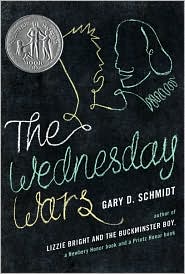
The Wednesday Wars-- A Minor Literary Campaign


Meet 13 year-old Holling Hoodhood: the only son of the only Presbyterian family in a neighborhood divided by Jews and Catholics. In other words, he’s the only kid who has to stay behind with his teacher on Wednesday afternoons while the rest of his classmates go to Hebrew school or Catechism class in Gary Schmidt’s 2007 Newbury Honor book, The Wednesday Wars.

The novel's title is inspired by Holling’s insistence that his English teacher, Mrs. Baker (who is a little testy, thanks to her husband’s serving in the Vietnam War), hates his guts, because she now has to spend her Wednesday afternoons alone with Holling, instead of enjoying afternoon tea with the her “Wives of Vietnam Soldiers” club. Holling’s proof that she hates his guts? In addition to assigning him such lowly tasks as banging erasers and cleaning the cages of Sycorax & Caliban (the class’ pet rats), she also forces him to read and perform Shakespeare (the horror)!

To complicate things further, Holling’s troubles do not end with Mrs. Baker. On the home front (better known as the “Perfect House”), he is forced into playing the unwitting peacemaker in battles between his budding flower-child sister, his stereotypical 1960’s housewife mother, and his overbearing, small-business owning, Walter Cronkite-loving father.

The novel progresses in a predictable manner, with Holling eventually coming to realize that not only does Mrs. Baker not hate his guts, but that there is actually more to her than he initially thought. Same goes for Shakespeare. The slapstick comedy scenes (think, “American Pie” for ‘tweens), is balanced by sobering reality checks from the Vietnam War. The end of the novel, though expected, is just the right combination of silly and sentimental to save it from the banality with which it dangerously flirts.

All in all, the book just didn’t do it for me (making me really wish I had read this book before I agreed to make it a part of my 6th graders’ curriculum). But, if you’re looking for a quick read, a few chuckles, and a good message, The Wednesday Wars will deliver--no Post Traumatic Stress Syndrome strings attached.

Sunday, November 9, 2008

Professionally Developed


Traditionally, when an administrator “asks” me to attend an outside professional-development training, I groan. Almost invariably, from the moment I walk into the local Howard Johnson/Best Western/Comfort Inn, slap the adhesive name badge on my breast, select from the continental breakfast buffet, and settle into my folding chair, these “workshops” become little more than a 6 –hour infomercial with the sole intention of selling us the latest book, learning kit, or software under the guise of imparting wisdom to a room of overworked, underpaid teachers who are already planning their escape during the “on your own” lunch break.

So, when my boss told me I had been registered for Walter Mayes’ “The Best New Young Adult Literature of The Decade” workshop, my reaction was much the same. But, since it didn’t seem I had much choice in the matter anyway, I figured, if nothing else, I’d get to sleep in, wear jeans, and leave a sub with my roomful of eleven year-olds on Halloween. If I was really lucky, I might even get a good list of new books to use for inspiring my students and my Fringe column. As it turns out, I got all of that, and a whole lot more.

The moment that 6 foot, 7 inch tall, former Jeopardy champion, Walter Mayes took the stage, I knew that this would not be a typical “training” session. As the Librarian and Media Specialist at The Girls' Middle School in Mountain View, California, Mayes is skilled in the art of engaging a dubious audience.

In addition to regaling us with stories of the liberal grandparents who instilled in him the love of all things literary, his experiences as a member of dozens of literary award committees, and anecdotes about trying to keep his library stocked with enough copies of the Twilight series (which he endearingly denounces as a “piece of crap”), Mayes provided exactly what we wanted: a list of the best new YA books, their appropriate audiences, and how to use them most effectively in our classrooms. Among his favorites? Gary Schmidt's The Wednesday Wars, Gordon Kormon's No More Dead Dogs, and Chris Lynch's Inexcusable.

Most importantly, though, he inspired us to turn the sour grapes of teaching literature to the unwilling into a sweet, sweet wine to intoxicate not only our students, but ourselves, with the love of reading.

Yesterday, I made a trip to the local bookstore, lightened my wallet, and weighted my tote-bag with 6 new books--the three mentioned above plus,Nancy Werlin's The Rules of Survival, Shaun Tan's The Arrival that I have only put down long enough to write this post.

So, for now, I’m off to do some reading. Be back next time with a look at Gary Schmidt’s The Wednesday Wars. In the meanwhile, listen to Walter read a clip from his book, Walter The Giant Storyteller's Giant Book of Giant Stories

Wednesday, October 15, 2008

Writing The Wrongs


Kids today aren’t just disinterested in writing—they are downright terrified of it.

Blame video games. Blame the Internet. Blame cell phones. Blame any of the high-tech toys that too many responsibility-shirking adults are so quick to use as a scapegoat. But, the way I see it, distractions like these are only as strong as the internal motivation to avoid another task. So what is it? Why is “writing,”—an activity that so many, historically, have used as a vehicle of rebellion, self-expression, and liberation, not more attractive to angsty, contrary teenagers?

What I saw in my classroom this week has led me to my own hypothesis. And, at the risk of sounding like a turncoat, I say: the real onus is on teachers.

“Miss Carey?” One overachiever asked, “Will you take points off our writing if we have more than 8 sentences in a paragraph—or less than six?”

No, honey, Mrs. So-and-So probably told you that because that’s the way the state testing Gestapo is going to decide how worthy you and your teacher are on the MCAS this spring.

“Miss Carey? What do you mean good poetry doesn’t have to rhyme? Are you saying that Jack Prelutsky isn’t the greatest poet who ever lived?”


Yes, dear. That is what I’m saying. If you were told otherwise in the past, it’s because your teacher was as afraid of poetry as you are.

“Miss Carey? Will you make us write as a punishment if we do something bad in class?”


No, son. I also won’t bludgeon you with a calculator and then try to make you a better mathematician.

It goes on. The truth is, I haven’t done much at all in the way of actual writing instruction so much as I have trying to reprogram 60 brains and convincing them that, despite what has been instilled in them with all the fire and brimstone of a Catholic upbringing, writing is not just another set of rules and regulations cast upon them by generations of old-dog teachers who refuse to learn new tricks. So far, it seems to be working, but it’s going to be a long road.

I’ll let you know how it goes.

Wednesday, October 1, 2008

Fever-Stricken


Laurie Halse Anderson is one of the most gifted young-adult authors of the 21st century. Her 2nd published novel, Fever, 1793 tells the story of 14 year-old Matilda Cooke, strong-willed heiress to her widowed mother’s coffeehouse in post-revolutionary Philadelphia, and is a quintessential example of the higher-standards required of today’s young adult literature (R.L. Stein, take note).

For the history lovers, there are the historical names, places, and details of the worst yellow fever epidemic in U.S.history intricately woven into Mattie’s story. There’s the dry-heave-inducing accounts of yellow fever’s symptoms. There’s a sweeter-than-saccharine romance between Mattie and Nathaniel Benson, a ne’er-do-well, lowly painter’s apprentice in front of whom Mattie scandalously dares to show off her elbows (gasp!).

There’s Grandfather: General William Farnsworth Cooke “of the Pennsylvania Fifth Regiment,” who spends his days in the coffee shop, regaling the customers with stories of his days under General Washington, while doting on Mattie and his pet Parrot, “King George.” There’s Eliza: the Cooke family’s freed-slave chef who serves as a member of the Free-African Society and always shoots from the hip (“You’re too soft!” she tells Mattie, “You have city hands and a weak back. You wouldn’t last a week on the farm.”)

And, of course, there is Mattie, a typical teenager grappling with the woes of adolescence: awkward in her pubescent body, rebelling against her stoic mother’s rigid expectations while simultaneously seeking her hard-won approval, and trying to establish her own identity, under the most tumultuous of circumstances.

The novel begins with a sluggish introductory chapter which sets the scene and introduces the major characters, and through which I always have to coax my dubious students. But, by the end of chapter two, the story is catapulted into high-gear as it races towards the heart-wrenching climax (I am yet to make it through a read-aloud without tears), and a conclusion that leaves no loose ends untied as Anderson deftly concocts a well-balanced literary meal that is at once educational, suspenseful, and deliciously satisfying.

Tuesday, September 16, 2008

Young? Adult? Literature?

My favorite comedian, the late Mitch Hedberg, once cracked: “Every book is a children’s book as long as the kid can read!”

Clearly, this statement is little more than an uninformed generalization with the singular goal of eliciting a chuckle. But, I must admit, as a card-carrying member of the “Make ‘em laugh any way you can” brigade, the silly one-liner actually gave me pause. Because, more and more, Young Adult Literature that I see as a middle school teacher is taking on content and themes that, often, is more “adult” than “young.” The ensuing internal debate has become a sort of “Chicken or The Egg” conundrum that I’ve yet to resolve.

Then, upon being invited to write for Fringe, I was referred to another column in a popular blog on YAL. And, I totally dug the snarky, “I love the 80’s”-style reviews of books from our collective childhood, having consequently been inspired to unearth lots of dusty paperbacks in my basement. And, while it’s most certainly been quite a trip to revisit these characters and stories through grown up eyes, as I read, something strikes me. Though I feel very close to these books out of nostalgia, I can’t remember ever being to relate to them as a moody, lower-middle class kid, coming of age in the neon nineties.

And so, it is in the same spirit with which I immediately removed the archaic Where The Red Fern Grows, and A Wrinkle In Time from my sixth-graders’ required reading curriculum, that I have decided--for the purposes of this column--to stick to YAL. and authors from the last two decades. But I promise—no annoying little wizards. Ever.

Be back in two weeks, with Laurie Halse Anderson’s Fever, 1793.