Showing posts with label Jill. Show all posts

Monday, July 20, 2009

New Home


We've moved! The Fringe Blog can now be found HERE, as part of the fantastic new Fringe Magazine site! Check out the brand-new issue of Fringe, and while you're at it, please update your bookmarks, links, and RSS feed subscriptions accordingly, and as always, thanks for reading!

Friday, June 12, 2009

Review: Where Did You Sleep Last Night? by Danzy Senna


Danzy Senna subtitles her latest book, Where Did You Sleep Last Night?, as a "personal history" rather than a memoir. The difference between the two terms is subtle but important--the book is as much a chronicle of her ancestors and a racially-divided world as it is a story of her own life.

Outwardly, the book hinges on the relationship between Senna's parents: Fannie Howe, a writer from the prominent white Boston upper-crust, and Carl Senna, a black intellectual from fuzzy Southern origins. The unlikely couple married in 1968, full of hope and revolutionary zeal, only to divorce in 1975, their union a victim of alcoholism, domestic abuse, and the social pressures of an inter-racial marriage on the heels of the Civil Rights Movement. More significant, however, is the relationship between Senna and her father. At the book's core is the author's dogged search for information regarding her father's roots--an often exhausting and heart-wrenching search that propels her on a journey through the South.

I found myself completely wrapped in the tangled threads of Senna's family history, eager for her to solve the mystery of her heritage. However, there was something keeping me from becoming completely involved in the story--something in her tone that's always bothered me. Senna was a visiting writer where I attended college and I took a creative writing seminar with her my last semester of senior year. I don't remember much about her--only about the writing prompts she gave us, the circles we would form for peer review. I think it's because she never seemed fully present or fully invested in our development as writers. Something about her kept us at a distance, even when we were surrounding her at a long table.

Given that I had taken a writing course with her, I read the book on multiple levels. On one of those levels, I wondered if her multi-racial identity grants her writing an authenticity and depth that would be somehow lacking in my own. All of her books (two novels and this memoir) focus on this idea of racial duality--of the constant struggle for identity when there isn't just one constant. But what does it mean when you're just...white?

While reading the book, I couldn't help feeling like without some element of another ethnicity to add dimension and significance to our experience, we racially plain people are one-dimensional, flat, without substance. There is an underlying tone of scorn for her mother's side of the family, described at one point as "a crowd of screaming red Irish faces, or a room of tight-lipped dismissive Wasps who assume their own significance and wit and intelligence as if they were still central, despite the evidence to the contrary." It was frustrating to feel like our ethnicity alone defines us and how we feel, see, and think about the world around us. Perhaps this is because my experiences have never hinged on my race--a luxury I certainly don't take for granted; however, I would like to believe that it is the totality of our life experiences that define us--not just our DNA.

Thursday, June 11, 2009

Coming VERY Soon...

It's almost here! Thanks to your generous support and contributions, the new Fringe site will be ready to launch on June 29. Designing and building a brand-new site is a pretty complicated task, and we appreciate your patience and understanding as we work out the last few tweaks.

As part of the redesign, the blog will be fully integrated with the main site. Stay tuned for specifics and our new address. We can't wait to show off the new face of Fringe!

Wednesday, June 10, 2009

True Currency


"The only true currency in this bankrupt world... is what you share with someone else when you're uncool."


In a recent essay for Rumpus, Rick Moody confesses his dark past as a high school outcast. Ostensibly, this is surprising--though not necessarily a household name, Moody is very well-known in the literary set, and gained fame with his novel, The Ice Storm, which later became a feature film starring Kevin Kline, Tobey Maguire, and Sigourney Weaver. However, those who know writers and other creative types pretty well will tell you that most of us share a bond stronger than art--we were all tragically uncool in high school.

The main focus of Moody's essay is about Bill, a band composed of Bill Gage, a man with Down's Syndrome, and his brother John, whom Moody was friends with in high school. Moody sets the stage for his discovery of this band by describing his group of high school friends: a motley and eccentric group of outcasts that others called a "cult." They were fused together in their loneliness and creativity--talent that gets automatically labeled "weird" by teenagers everywhere.

I was, of course, uncool in high school, as were many of the most awesome people I know. The only thing that kept me going was my band of friends--like Moody's "cult," we didn't have much in common except for that subliminal quality that set us apart from the popular kids. We converted the small yearbook room at the back of the library into our headquarters--we monopolized the school newspaper, yearbook, and drama club. Nearly all of us were in band or orchestra, and on Friday nights, instead of partying, we made movies.

It all makes me wonder if being labeled "different," being jeered at, laughed at, and torn down is what makes great artists great (I am by no means implying I am a great artist. But at least I have some imagination.) This isn't to say that those popular kids won't go far--they will. But without that special brand of angst only found in lonely teenagers, we wouldn't foster the kind of introspection and pain needed to create great art--or some of the best friendships of our lives.

Thursday, May 21, 2009

Interview with Chamber Four--Part II


Here's the conclusion of our interview with Chamber Four:

Aside debates about the value of ereaders, and clips of other sources discussing the value of ereaders, what type of content are you trying to publish?

Sean: We're really trying to promote the book reviews as a source of book information for readers by readers. The database is growing steadily, and our ambitions for it are big; we'll be importing it to a searchable, cross-referencing database at some point, hopefully soon. We're also planning to launch a digital magazine soon.

Nico: I've always been frustrated with the way book reviews are done. Music and movie reviews are geared toward telling people if the music/movie is good or not, why aren't book reviews the same way? On the blog side, we also post about literature and reading, as well as ebook issues. I think our best posts are the more sprawling, big-picture pieces, because we're all in the midst of figuring out this tectonic shift in a medium that's been stable for almost 600 years, so I find pieces that can encompass the magnitude of that shift to be the most compelling. And while we do repost some big news items, we filter a lot of stuff out: our goal is to keep the lay ereader/literature aficionado informed without overwhelming him or her with the details of all the minutiae of either ereaders or publishing.


Is Chamber Four available for eReaders?

Sean: Right now the whole site is in a blogroll format, which can easily be compiled and added to ereaders through programs such as Calibre. When we launch the magazine it will be available for free in an ereader friendly download, probably as PDFs and ePubs.


As MFA students/graduates, how do you see eReaders changing the way writers try to publish?

Nico: I think the big difference is that anybody can publish their own ebook. One thing we need, as more and more books are published every year, is a filtration system…In a world of digital distribution, hopefully there will be a lot more room for small press books to get a more equivalent share of notoriety because the cost of distribution will be leveled out. For writers, it means that simply getting published will no longer be a goal in and of itself.

Sean: Right, but hopefully writers will remain focused on creating the best art they can. We know good authors will still be good, regardless of the format their books are delivered in.

Nico: Another great thing about digital publishing is that it allows for more experimentation. If we start seeing more ebook-only publishers, their books won't necessarily need to all be 300 pages anymore, and their books won't need to have huge audiences because the costs of production will be much lower.


What is your take on self-publishing?


Nico: I just want to read good books, I don't care where they come from. I think the biggest problem with self-published books is that the good ones can easily be missed.

Sean: The prohibitively steep costs of publishing make things especially difficult for unpublished writers. Self-publishing can help dedicated writers get their stuff out there for all to read, even if a firm won't take a risk on it. eBooks certainly help in this regard. Of course, the volume of poor quality self-publication will likely increase with ebooks (it already has), but like with their deadtree counterparts, if it isn't good, no one will read it anyway.

Currently, your site is ad free. Will that be changing in the future?

Sean: We're going to try our best not to change that. We toyed with ad space, but with our focus toward unbiased reader advocacy, we didn't want a bunch of Kindle and Sony ereader ads popping up all over the place. When the Kindle 2 came out, Amazon gave a 10% cut of any sale to the site that referred the buyer. This caused a weird imbalance in Kindle reviews, despite the fact that in the best light it is no better than its competition. We didn't want to be a part of that.

When does Chamber Four plan to start a literary magazine? How do you hope to distinguish yourself from other literary magazines? How does starting a literary magazine fit into the site's overall mission?


Sean: Our hope is to launch the first issue in the autumn of 2009. Each issue will be available for DRM-free download at no cost. Too often, stuff printed in lit journals tends to read as if it was written on only for other writers, perhaps because they are mostly read by other writers. We want to do something different.

Nico: To a certain extent, it's us putting our money where our mouth is. We think digital publishing is the way of the future, so we're going to get into it, and see what we can do. We're going to have to stay quiet on specifics for now, but the magazine will definitely be reader-centered, like the rest of Chamber Four.

Wednesday, May 20, 2009

Interview with Chamber Four--Part I


Fringe has been collaborating with Chamber Four on an interview swap to exchange information about digital literature. It's been an interesting dialogue--the interview with Fringe's Editor-in-Chief Lizzie Stark can be found here. Now it's Chamber Four's turn to answer some questions! Lizzie sat down with Chamber Four founders Sean Clark and Nico Vreeland (Eric Markowsky wasn't available, due to a little thing called his thesis) to talk about writing and reading in the digital revolution.

Part I now, Part II will be published tomorrow.

Why did you decide to start this site? How did you come up with the name? Who are its founding members and how long did it take you to get the site up?

Sean: The three of us (Eric, Nico, and Sean--all from Emerson College's MFA program) came up with the idea while discussing books and Nico's new Sony e-reader. We actually got the first build put together after a long week of work, but some of our planned improvements are still being worked on. I think an enormous disconnect seems to exist between readers (and to an extent writers) and publishing as a business. Since finishing school, I've longed for a better way to discuss and share good books. The name references William Blake's Marriage of Heaven and Hell.

Nico: I had a whole lot of trouble finding good information about e-readers, especially the Kindle. After a lot of research, I found out that the Kindle has a lot of downsides: you can't borrow digital library books with it, you can't buy any book not sold through Amazon, and you can't buy much of anything that isn't crippled with DRM. So a big part of Chamber Four is detangling the mess of e-reader information out there. The other parts, like our book reviews, evolved out of that desire to inform readers, and our frustration as readers ourselves with the publishing and e-publishing industries.

There is endless debate about the role of e-books in literature. How does Chamber Four contribute to this dialogue?


Nico: We all like ebooks. We try to analyze how readers will be affected by the digital publishing revolution. A lot of sites and organizations look out for authors and publishers and publishing professionals, but very few honestly break down the effects all of this will have on readers. For example, a lot of publishers tell you that digital rights management (DRM) is necessary to protect their investments or stop piracy. But DRM drastically limits the way people can use ebooks compared to paper books, and there's no research to support claims that DRM actually prevents piracy.
Sean: The less difference people see between books and ebooks, the better. In any format, literature is words placed together in a precise order by a writer. However, there are a lot of opportunities for books and book distribution to flourish and improve in a digital environment, and readers will have unprecedented access to everything ever written. Basically, our stance is that people should read more, and in what manner they choose to read is secondary to that.

E-readers are slowly becoming more mainstream, but don't seem to be there quite yet. What do you think will be the tipping point?

Nico: It's important for ereader skeptics to actually see one. That said, the technology isn't quite there yet. Another few years of development will do wonders. Other than that, I'm not sure there will be a tipping point, exactly. Ebook readership picks up every year, and I think that will continue until basically everybody reads ebooks.

Sean: The term we (well, Nico) coined for this moment is the Great eReader Adoption. And Nico's right about actually seeing and manipulating an ereader. I still do most of my reading on paper books, but I actually find reading on an ereader quite comfortable. For me the turn off is the DRM. The tipping point for ereaders will likely be most evident when schools and textbooks make the switch. Younger readers will lead the push towards these devices being an everyday necessity.

Nico: Yeah, getting rid of DRM is one of the drums we bang. There are already horror stories of Amazon locking people out of the books they paid for and they can do that because almost everything they sell you is crippled with DRM, which means that you don't own it, you only license it.

Is DRM really all that bad? In this media market, where the demand for books, and for literary fiction in particular, have been dropping, when fewer people than ever are willing to shell out $25-50 for a hardback, why should publishing companies (and authors) give the public an infinitely replicable file for less than $10? Wouldn't doing so make the already not-very-lucrative profession of book writing even less appealing? Authors need royalties in order to continue writing.

Nico: Yes, it's that bad. First of all, DRM does not prevent piracy, which is ostensibly the whole reason it exists. What DRM does do is cripple media by locking music and books to specific machines by brute force. There are also horror stories about Kindle users getting locked out from their books and music buyers losing the DRM keys to their music.

Essentially, DRM means that you don't own the music or ebooks you buy; you only license them, and at some point that license will expire. I've personally had a lot of trouble trying to put old DRMed music onto new computers, or different mp3 players—and I've had trouble moving ebooks from one ereader to another. And you can forget about borrowing a friend's book like we're all used to.

DRM exists because media companies see every illegal download as a lost purchase. But I don't believe that's true. As Neil Gaiman said in a talk a while ago there's a long history of people discovering new writers or artists by borrowing books and music from their friends. There has to be a lot of experimental downloading—people trying new music or movies that they would not purchase otherwise—which is a good thing for authors and musicians, especially struggling ones for whom notoriety is of the highest importance. Plus there's new research out that suggests downloaders buy more media than non-downloaders.

Sean: I'm the type who obsessively organizes iTunes, makes sure every album has cover art, a genre, etc. A big reason why I haven't made the shift to a digital library is that DRM prevents me from doing this with my ebooks. A lot of DRM systems also feed into proprietary formatting, which is especially frustrating, and fragments the market in a way that isn't good for readers or writers. DRM forces a situation where nobody wins besides the guys selling machines for twice the cost of production. And don't forget, right now anyone can read any book they want, totally free and legally: just walk into a library. DRM does nothing to help authors (exposure helps them more than anything); it merely perpetuates a failing business model.


Do you see a place for ebooks in bookstores, or will bookstore giants suffer for the cause?

Nico: My heart doesn't quite bleed for Borders. When big corporate bookstores try to dictate which books readers buy, the whole publishing industry suffers. I sincerely hope ebooks reduce the power those bookstore chains have.
Sean: If Amazon, Borders, and other big corporate bookstores strong arm their way to exclusive deals (both ebook and deadtree) and forgo the publishing houses altogether, I think we'll see a real decline in quality publication, as good literature makes for risky sales.

We're already seeing bookstores set up digital kiosks for selling ebooks. E-books can provide publishers the opportunity to produce more great titles at a fraction of the cost. My hope is that ebooks help them produce and sell stuff we want to read that will also make them the money to keep in the ring with the big boys.

Monday, May 11, 2009

Vernacular Spring Gala--THIS Friday!


The members of Emerson College’s literary blog, VERNACULAR, are proud to present:

Vernacular Spring Gala
An evening of live music, food and drink, and social networking

Join us on Friday, May 15th from 7p.m.-10p.m. at GRUB STREET (160 Boylston St, Boston, 4th floor) for a chance to mingle with local publishing professionals, writers, bloggers, students, and Emerson College faculty. Check us out at www.vernacularlit.com for details about the event, and to purchase discounted advance tickets! ($3 advance / $5 door) Free booze and food included in ticket price-- yes, really!!

Live music provided by Gentlemen Hall and Heinz Healey Schaldenbrand; food provided by Teele Square Cafe; drinks provided by Narragansett Beer and Equal Exchange Cafe.

I challenge you to find a better deal in the city this weekend! See you there.

Note: You must be 21 years of age to consume alcoholic beverages. Food and drink will be provided while supplies last.

Wednesday, May 6, 2009

Mission: Accomplished!

Thanks to all of you, Fringe has reached our fundraising goal (and then some)!

You can look forward to a hot new design coming to Fringe in June. We hope you're all as excited as we are.

Tuesday, April 28, 2009

New Blood

Along with the approaching redesign,
the gorgeous spring weather, and our interactive Round Robin story project, we at Fringe are excited about a few shakeups going down behind the scenes.

We are pleased to announce two new editors joining the staff with our upcoming June installment! Llalan Fowler has taken the reigns of our nonfiction section from Shuchi Saraswat, who has shifted to fiction editor. Llalan is the editor of the Globe Corner Bookstore blog, writes a weekly column about beer for Bostonist, and also writes weekly for Emerson College's Writing and Publishing blog, Vernacular. She is also a worthy arm-wrestling opponent and devoted Cleveland Indians fan.

Dara Cerv is helming our (de)Classified section. She has an MFA from Emerson and continues to be a Boston-area poet. Her work is forthcoming in Sixth Finch. She's currently working on a chapbook of love poems that really aren't love poems at all.

Please join us in welcoming Dara and Llalan to the Fringe family!

Monday, April 27, 2009

On Keeping A Notebook


"The impulse to write things down is a peculiarly compulsive one, inexplicable to those who do not share it, useful only accidentally, only secondarily, in the way that any compulsion tries to justify itself."--Joan Didion, from the essay, "On Keeping a Notebook"

My first notebook came to me as a Christmas gift from my sister when I was six. She had made it in a crafts class at the junior high, and it was pink, with multicolored paper pages and the word "diary" stamped in gold on the front cover. Though I wrote in it sporadically, I didn't start keeping a faithful journal until the winter of my freshman year of high school. Writing in a notebook is a practice I've kept up with, more or less regularly, since starting that random February day. I keep twelve years' worth of notebooks in a large red storage bin in my closet here in Boston. About once a year, on some rainy Saturday, I'll pull one out and start reading. Half-forgotten memories can pull me in, sometimes for hours at a time, but mostly I tire of myself quickly and put it all away in disgust. But I would never throw them away.

In her essay, Didion says she doesn't keep a notebook as any kind of attempt to record the facts of her daily life or to fossilize the events of the world around her. So then, why? Why bother writing random snatches of thoughts, imagined encounters and half-remembered lines of dialogue? "Remember what it was to be me: that is always the point...our notebooks give us away, for however dutifully we record what we see around us, the common denominator of all we see is always, transparently, shamelessly, the implaceable 'I.'"

I had never questioned why I keep a notebook before reading this essay several weeks ago. It's just something I've always done, for better or worse. A compulsion to write things down, as Joan calls it. Though I now write for several blogs, once kept a livejournal, and can type faster than I can write, it's always been a notebook and pen that I come back to. Something about having a physical record gives me comfort.

It always surprises me to learn that some writers don't keep personal notebooks or diaries. There's nothing much of note or interest in my notebooks, except to me, but writing there helps me sort out my thoughts and get out my angst.

How many of you keep journals or notebooks? Do you have a routine or schedule?

Wednesday, April 22, 2009

Newburyport Literary Festival


Looking for something to do this weekend? The weather promises to be gorgeous here in New England, so why not take a trip to Newburyport for the 4th Annual Newburyport Literary Festival?

DATES AND HONOREES ANNOUNCED FOR THE

FOURTH ANNUAL NEWBURYPORT LITERARY FESTIVAL – APRIL 24 – 25, 2009

Mission of Fourth Annual Festival is to Encourage “Reading for a Lifetime”


Newburyport once again welcomes local and national authors and readers alike to celebrate “Reading for a Lifetime” at the Fourth Annual Newburyport Literary Festival (NLF), organized by the Newburyport Literary Association, on April 24 – 25, 2009.

Located in Newburyport, Massachusetts, with its rich literary heritage, the NLF is a unique opportunity for local and nearby community members to meet with and to hear from well-known authors from every genre in a picturesque setting.

NLF 2009 Honorees include:

David McPhail – McPhail is an award-winning author and illustrator of nearly 200 books beloved by children, parents and librarians across the United States. McPhail is one of the most prolific and influential children’s authors in the country. McPhail has garnered many prestigious awards, including a New York Times Book Review Best Illustrated Book of the Year for Mole Music in 2001.


Dorothy LaFrance - LaFrance recently retired from the Newburyport Public Library after serving as Head Librarian for 30 years. In addition to functioning as a City Department Head, she is a former past President of the Merrimack Valley Library Consortium. In Newburyport, she is a member of several organizations include the Cultural Alliance Roundtable and the Lifelong Learning Lyceum.

“This year as the Newburyport Literary Association prepares for our fourth festival we are delighted and proud to announce our honorees,” stated the NLF Chairperson, Vicki Hendrickson. “We are so fortunate to live in a community where reading is valued and where we have folks like Dottie and David who are here to guide us along the way.”

Confirmed authors include Anita Shreve, Julia Alverez, Elinor Lipman, Richard Bausch, Peter Orner, Lewis Turco, Anne Easter Smith, David Crouse, and, of course Newburyport’s own, Andre Dubus III.


The Newburyport Literary Festival (NLF), organized by the Newburyport Literary Association, annually celebrates the joy of reading and writing as well as the love of books. The NLF in 2009 features more than 40 writers of distinguished fiction and non-fiction – including short story writers, children's authors, biographers, nature writers, critics, screenwriters, poets, novelists, and journalists – who will read and discuss their work in venues throughout Newburyport's historic downtown


For more information on the NLF, including authors and their work, please visit www.newburyportliteraryfestival.org

*Photo courtesy of David Miller

Thursday, April 2, 2009

Playing Guitar for Charity

Sounds too good to be true, right? Wrong. Wednesday, May 6, Everybody Wins Metro Boston is hosting a fundraiser to benefit the literacy program. I've been volunteering as part of their Power Lunch program since last fall, traveling to a South Boston elementary school once a week during my lunch break to read to William, a third grader. It's been a great experience, and besides the benefits of exposing kids to reading, I'm rediscovering my own love of Curious George, The Magic Schoolbus, and The Bearenstain Bears.

Structured like a "Battle of the Bands," this Guitar Hero fundraiser gives participants the chance to form their own bands and then duke it out for ultimate rock star supremacy. As if that's not enticing enough, when else can you say you're playing video games "for the kids"? It's a no brainer.


{Cross posted to Vernacular}

Wednesday, March 25, 2009

Reading Rodeo--Cowgirls and Couplets Dirty Water Reading Series SUNDAY 3/29


The time has come again for the Dirty Water Reading Series to invade Grub Street headquarters! Join the fun this Sunday as Black Ocean, Quick Fiction, Redivider, and, of course, Fringe, present readings from Zachary Schomburg, Emily Kendal Frey, Blake Butler, and Fringe's own (de)Classified editor, Dara Cerv.

There will be high-falutin' fun, like the perennially popular literary MadLibs between each reading, a raffle, Texas-style suds, down home grub, and country tunes. There may even be some square dancing, you never know.*

The Details:
Sunday, March 29th at 7 PM
Grub Street, 160 Boylston St., Boston MA
Suggested Donation: $1

Hope to see you there!

*There will be no square dancing.

Sunday, March 1, 2009

Keeping up with Thoreau


Fringe's Special Enviro Issue debuted today, featuring literary selections with a special focus on green and environmental topics. Fringe isn't the only journal looking toward the environment for inspiration, though.

Ever since Henry David Thoreau famously "roughed" it on the shores of Walden Pond, writers have used their natural surroundings as fuel for their creative fires. Lately, though, this environmental concern seems more omnipresent than ever. While staffing my company's table at AWP, I was surprised by the number of people who asked if we published any nature writing anthologies. We don't, but it got me thinking that it's a good avenue to consider pursuing, since it's obviously a hot button issue that's in demand and in the forefront of our global consciousness.

I also came across two literary journals while at AWP that focus primarily on the natural world. The Fourth River is a journal run out of Chatham University in Pittsburgh, and "welcomes submissions of creative writing that explore the relationship between humans and their environments, both natural and built, urban, rural or wild. We are looking for writings that are richly situated at the confluence of place, space and identity, or that reflect upon or make use of landscape and place in new ways." Instead of the ubiquitous pins and postcards, they were giving away envelopes of wildflower seeds, which I found smart and charming as a marketing tactic.

flyway journal is affiliated with the MFA in Creative Writing and Environment program at Iowa State University and has just recently devoted the journal exclusively to publishing writing about the environment, though the journal is 15 years old and has always been linked to the unique environmental writing program.

One thing I find myself wondering about these two journals is if they are so dedicated to the environment, then why are they both print journals? Shouldn't they consider becoming online only, thus saving the paper, ink, and other environmentally-destructive resources traditional media necessitates? Just a thought...

Monday, February 23, 2009

What a Difference a Year Makes: Reflections on AWP 2009

I returned from my second AWP conference exhausted, laden with lit journals and assorted swag, and feeling a mixture of inspiration and disappointment. I promptly took a long nap, and only after I woke up the next morning was I able to properly begin processing the 4-day hurricane known as AWP.

This is not to say that this year's conference was somehow more tiring than years past--AWP is always a hectic weekend full of readings, panels, drinking, and dancing, but this year's conference came with many added dimensions for me: responsibilities.

I attended the 2008 conference in New York City as a student--a Publishing student, no less. I had nowhere to be other than the panels and readings I had painstakingly circled in the official program. In my free time, I perused the Bookfair, but I was quickly overwhelmed by all of the smiling lit journal editors asking "What do you write?" It's a seemingly simple question, but for me, it's always been a loaded one. Having attended Emerson, where the dual-focus writing program is both a blessing and a curse, my identity as a writer has gone through more than a few crises. Since students in the Publishing program are not widely regarded as writers (most MFA Creative Writing candidates forget the "& Writing" part of the "Publishing & Writing" concentration), I tend to deny that I have any kind of writing talent. When too tired of responding "I write nonfiction," and feeling like a liar (though I do write, I do so primarily for myself), I would head back to the hotel I shared with 4 other Emerson students or go for a walk around the block to see where I could find the cheapest sandwich Midtown Manhattan had to offer (it wasn't always the least sketchy option). I saw readings by Joyce Carol Oates, Jonathan Safran Foer, Billy Collins & Frank McCourt, and Mary Karr.

This year, I flew to Chicago to attend AWP in a more official capacity: the company I work for paid for me to go, to represent them at the bookfair. We publish college textbooks, and a first edition creative writing book, Creative Nonfiction, had just published a month ago. In addition to my official post at the Bookfair, I was to take the author to dinner and meet with one of our freelance contributors to discuss a project.

Beyond my official capacity, it was my first AWP as a Fringe editor. Though I wasn't able to represent at the Fringe table, I dutifully schlepped a duffle full of swag (shot glasses, samples, pins, magnets, and the banner) to Chicago and back to Boston, and stopped by the table as often as I could.

I was surrounded by friends and colleagues, I was representing my company, and I was part of a literary journal I believe in. But I left AWP this year feeling somehow less inspired and less part of the literary community. Why was this? I collected my fair share of free pins, journals, and temporary tattoos; I attended every dance party; I signed up for a subscription to Gulf Coast, bought a back issue of Barrelhouse, and subscribed to Paper Egg books. I chalk it up to a combination of things: I didn't attend a single reading, I was working the bookfair the entire day with a smile pasted on my face, and I got more than a few scorned looks from people walking by my table. I was there representing "the man," despite the fact that many of the conference's attendees are professors who use our books to teach classes and the panel offered on textbook writing was so crowded that I had to sit on the floor.

This post is pretty disjointed. A week later and I still can't quite decide how to feel about AWP. I am also suffering from a nasty case of the dreaded "post-AWP plague," so my head is foggy with cold medicine and congestion. I don't know if I'll be in Denver for AWP 2010, but if I am, I hope to find a balance between representing "the man" and myself.


*Cross-posted to Vernacular*

Thursday, January 29, 2009

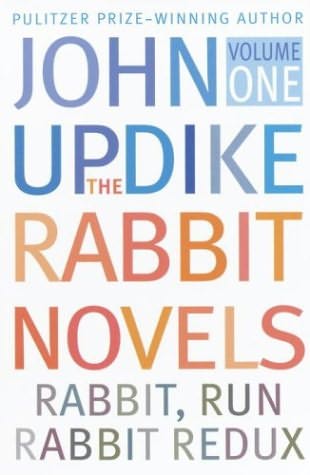
Weighing in on Updike Part IV


Let me start off with a confession: I have never read a John Updike novel. Despite this deficiency, he remains in my mind as one of the most, if not THE most, prolific literary writers of our time, standing shoulder to shoulder with Joyce Carol Oates and Philip Roth, giants of American literature.

Updike's "A & P" was the first short story we read in my freshman year composition class in college, and I still remember reading his description of Queenie, the pubescent temptress who slaps barefoot into the local A & P to change Sammy's life forever: "With the straps pushed off, there was nothing between the top of the suit and the top of her head except just her, this clean bare plane on the top of her chest down from the shoulder bones like a dented sheet of metal tilted in the light. I mean, it was more than pretty." Sure, he was a classic "man's man" writer (just a paragraph before, Sammy wonders parenthetically if girls really have a brain or if it's "just a little buzz like a bee in a glass jar"), but his deft use of language and tone more than made up for the often less-than-favorable portraits of females in his stories (taken with a grain of salt, as usual).

In my first grad school literature course, we read "Pigeon Feathers." I don't remember what other stories we read that week, but I do remember it was a decidedly more concise writer that our teacher contrasted with Updike's winding and dramatic story on God and the nature of mortality. I was the only one in the class who preferred Updike's style--I appreciated the lyricism of his language, and how he used it to illustrate larger issues that hulk in the corner of all of our minds.

I'm not the only one who remembers Updike fondly. For more remembrances of the author, check out these tributes:
Vernacular
NPR
The New York Times
Los Angeles Times
the New Yorker
the Guardian
the San Francisco Chronicle
the Chicago Tribune

Thursday, January 8, 2009

Women Do What?


Most of us are aware that women are awesome and capable of just about anything. However, sometimes people seem to forget that while we are able to give birth, run countries, and cure diseases, we also do crazy things every once in a while, like drink beer and tell jokes. Weird.

Former Weekly Dig staffer Lissa Harris has noticed the slightly disturbing trend of the "look at women[insert completely inane and irrelevant activity here]!" headline and decided to create a blog dedicated to calling attention to these stories. Women Do! is just getting off the ground, so if you know a good story that meets this criterion: "The true Women Do story is not about medical issues, or gender discrimination, or anything properly related to women qua women. Oh no. It is about the shocking spectacle of women doing stuff that people generally do. At its heart is typically an earth-shattering revelation that some women, for instance, like to drive motor-cars or eat ice-cream.", be sure to send your tip to womendoblank[at]gmail.com.

Sunday, December 21, 2008

Writing on the Fly

Former Fringe Blogger and Redivider Fiction Editor Matt Salesses has pioneered a new project he calls "Live Essays: An Experiment in Up-to-the-Minute Nonfiction." The tagline: "I have decided to post this essay as I am writing it, and to write it as it is happening. We'll see what comes of this. Other essays coming soon?"

It's an interesting approach, for a couple of reasons: 1. Matt is primarily a fiction writer. 2. Matt is living in Korea, teaching English. 3. The immediacy of the writing tends to create a sense of intimacy that we wouldn't normally get from an essay, as we feel we're reading as the action is happening.

This breed of insta-writing is popping up elsewhere, as well--the cell phone novel has become one of the most popular literary forms in Japan, according to this week's New Yorker article by Dana Goodyear. Sites like the Japanese Maho I-Land cater to young writers who can tap their tome as if texting on their cell, and then upload it directly onto the site, where readers can follow the installments as quickly as they're written.

It is a phenomenon both thoroughly modern and a bit antiquated--popular novels were often serialized in newspapers in the days of Dickens, letting readers easily digest stories in smaller chunks.

The idea of "instant nonfiction" posted online does raise a couple of questions, though. Where is the line that separates an "essay" from a "diary" from a "blog"? If we consider that an essay is typically a structured piece, building on a central theme, with a defined question and exploration of that question within, does this method leave room for that kind of analysis? Or is this the "new, new, new journalism"--instant, easy to swallow bits of information, delivered to the reader daily and free of charge?

Wednesday, December 10, 2008

Dirty Water Reading THIS Sunday!


Nothing says "Happy Holidays" quite like lewd mad libs, spiked eggnog, and literary offerings from four Boston lit journals: Fringe, Redivider, Quick Fiction, and Black Ocean.

Hear Sean Lanigan, Oni Buchanan, Pamela Painter, and Fringe's own Kim Liao as they share tales of family cheer so dysfunctional, you may actually find yourself grateful for your own family this holiday season!

As always, each reading will be punctuated with interactive Mad Libs (in the form of classic carols), a raffle, and free snacks and libations.

Come for the readings--stay for the eggnog.

Dirty Water Reading Series
Sunday, December 14, 2008 7pm
Grub Street
160 Boylston St, Boston MA 02110
$1 Suggested Donation

Friday, December 5, 2008

Fringe 17: Large and In Charge


The last issue of Fringe for 2008 is live--check it out for your quarterly dose of innovative and evocative writing and art from our impressive list of contributors.

As winter begins its descent, we (Bostonians especially) often begin to feel imprisoned by nature, chained by the shackles of snow, ice, and bitter winds. Much of the work featured in this winter's issue deals in some way with our universal struggle to overcome those boundaries (whether it be our social phobias or a giant glass bottle) imposed by the world around us:

  • Cati Porter's multimedia poem "Fructify" is a quiet, almost haunting, verse about a woman who "wants to scream/but her mouth has become a honeycomb"
  • Jean-Michel Buche's artwork is clean and organic; tightly organized and meticulously detailed, it's reminiscent of cells and science--of the things it takes to build a life.
  • In "Some Things I Just Can't Talk About," Casey Wiley tells the story of Tim, a man who can't quite seem to get over the pain a certain Uno's manager caused him, as he goes through his days railing at the world.
  • It's no secret that small town America is becoming not much more than a fairytale our parents tell, but Kelley Calvert renders the gradual death of her hometown in her essay "Somewhere Between Everywhere and Nowhere" so poignantly that you find yourself yearning for a trip to the local drive-in after a burger and shake from the malt shop.
  • Tisha Nemeth-Loomis's first in a series of 3 poems is titled "As if constriction was our first allegiance": "hankering I am little kernel too corpulent/for the husk"
  • Following the nature theme, Geoffrey Detranis' 3 Electra poems also draw compelling parallels between our bodies and the natural world: "She coughs fruit, a plum in the larynx."
  • Megann Sept's short short, "Flash Flood" intricately layers the story of a close call during a hiking trip, a mesmerizing painting, a childless art collector, and a young introvert who "would love to be known as the girl who says inappropriate things."
  • "Notes from a Man Trapped Inside a Giant Bottle" is a chain of pleas for help from Robert Ebenhoe, a man who is quite literally trapped. Mark Brinker's story is at turns hysterical and pathetic, so much so that we don't quite know whether to root for Robert's rescue, or hope that he stays in there so we can read more.
  • Anna L. Cates' criticism, "The World Comes Together: Dual Identity in the Poetry of Sam Hamod" examines the duality of the American immigrant experience as expressed by the poems of Lebanese contemporary poet Sam Hamrod. Even while immigrants may yearn for the quintessential American experience, they can never fully leave behind their roots, thus creating new dimensions in their writing.

    Remember: Fringe is here, to provide an escape when you're beginning to feel caged in by the cruel, cruel winter.
Art: "Mopti" by Jean-Michel Buche