Showing posts with label Victoria. Show all posts

Thursday, November 20, 2008

Savvy Context: Editing with Technology


A few years ago I was pretty sure I knew everything about Microsoft Word. Of course, the day I hit the "Track Changes" button, I realized I'd been missing out on something huge. Those of you in the publishing world might have had a similar revelation, but in my short time in the field, I've realized some people are still missing out. For the sake of my own sanity--not to mention yours--I'm not turning this blog into a Word tutorial. If you're looking for instructions, head over to Microsoft's website.

The benefits are pretty easy to identify. You can
  • literally record everything you change while you type
  • insert comments and queries just like you would while line editing a manuscript
  • and keep track of multiple reviewer' comments.
Of course, Word isn't the only program out there, and track changes is native to most word processing applications (or maybe all? I admit I'm not an expert across platforms). The editing process can be started, tracked, and archived using these programs, and where editorial assistants had to print tens of thousands of pages a week (yes, an accurate estimate), they are now capable of simply managing one soft copy as it progresses through the ranks of editors and proofers.

An individual editor who switches to a strictly electronic review process can only make so much of a dent in the practices of an entire company. Unless entire work-flows shift to make use of technology, the costly inefficiency will continue. While I entirely respect the creative process and some writers' need for paper, I just don't think editors should continue working without electronic editing and work-flows. Undoubtedly the transition will be tough and we'll all have to get better at working with the programs our companies chose to use. The thought that we can do away with time consuming copying, bulky print-outs, and all the energy we currently spend manually tracking changes in a manuscript just outweighs the work we'll do changing our habits.

Next blog, I'll be bringing in some real life examples of how technology has helped the editing process (beyond the copy-paste revolution, of course) and hopefully have thoughts from people getting the most out of their electronic resources. Until then, I'd love to hear what you all have to say: any EA's out there dying to stop copying? Or any that think it'd be impossible to switch?

Thursday, November 6, 2008

Savvy Context: Odds and Ends of Writing Media

Alright, some last words on why you write on computers or on paper.
On the whole, I prefer writing on paper. I have to put something down everyday. I keep a journal so that even if I'm not working on something, I have an outlet. For me it's not just the paper that's addictive because I also have a slight addiction to fancy, colorful pens.—Kandi H.
[After considering that others might not understand her process]…that is writing, I guess. The experience is different for everyone..-- Aimee L.
…I type things that enter my mind with great speed, leaving no time to process what I'm writing as I write it and to, thus, create more to continue on….I write briefly and stop for several minutes, watching the blinking text cursor rhythmically taunt and jeer me as I try to think of what comes next. When I write by hand, the process is slower and capable of marinating in its own juices. I recommend both paths--handwriting and typing, especially since the latter has spell-check--for the reasons previously stated.—Lynz M.
I think computers have made it easy for a lot of bad writing to get out there - bigoted blogs, formulaic novels, inaccurate reporting - all rife with punctuation and grammatical errors…Overall I think computers have helped writing - but please don't get me started on e-books.—Tanya P.
As much of a techie as I am (I almost never write on paper), I still can't imagine writers giving up on paper in the foreseeable future. And as content creators, writers are just as valuable in the transition to all electronic formats as the readers are important as content consumers. So we're all in agreement: you can't cut paper out of the writing game just yet. Will we ever be able to?

Friday, October 31, 2008

Savvy Context: The Crowd Weighs in on Computers

Bonus post between weeks!
(See, I told you I'd make it up to you!)

Last time I talked to proponents of writing on paper. Here's what the other side had to say:
I tend to use the computer mostly in the editing/refining stage. For me there's also a distinction to be made here between creative writing and academic writing….I like using the computer for academic writing because it allows me to start with an outline and then flesh things out little by little. —Kandi H.

When I wrote everything on paper first, I was always carrying a notebook around with me, often a large one. Now I…don't worry about always being prepared to write the next part of the story. Also, you don't really have to worry about losing the page that you just wrote your most brilliant scene ever on. And there's always spell check and the backspace key. I got really tired of not being able to easily change large sections on paper. –Aimee L.

I love the feeling of my laptop's keys beneath my fingers. It propels me to type something--anything--with no aim or purpose (most of the time). I start typing, and I watch as something unfolds: a long overdue email to an old friend, a quick online message to a new friend, or the beginning to what I hope will be the story that changes the world.—Lynz M.

If I'm writing on a computer, sometimes I like to start in the middle. I can write papers or stories in chunks and then rearrange, add and subtract as necessary….Computers help me write because they make it so fast and easy to generate, alter, check grammar and spelling, etc. But they also make it easy to agonize over one sentence, rewriting and deleting, until you drive yourself crazy.—Tanya P.
So which side are you on?

Tuesday, October 28, 2008

Savvy Context: The Crowd Weighs in on Paper

First, I apologize for a belated post! I promise I'll make it up to you!

Instead of writing this post from inside my own little bubble, I asked some friends what they thought of writing on paper.

I find that it's much more satisfying for me to put the ink on the page myself rather than relying on a computer. I think that writing on paper makes the writing more personal. —Kandi H.

I hand wrote on paper for many years. I still do sometimes. There's something about it that's easier, like a connection from my hand to the pencil. I was also very against using pen….[Writing on paper] really just help[s] me get my ideas out. Staring at a blank sheet of paper just makes me want to write something in a way that a computer screen won't.–Aimee L.

I always begin writing on paper; my initial draft is always written the same way I would talk to someone. Once the ideas are laid out on paper, then I can circle, draw, scale, move, exchange the phrases and words into a more comprehensible idea rather than just blurbs on paper. I usually re-write at least 3-4 times; it's also helpful to track my changes and watch the birth of a masterpiece throughout the entirety of its evolution.-- Jenny A.

[The lone male voice in the room simply pronounces its preference] I always write on paper.—Stan S.

Next time, the computer people will have their say. Until then, where do you stand and why?

Thursday, October 9, 2008

Savvy Context: The Writing Process, Part 1


The words “publishing” and “technology” are hot topics these days. The Google news search results wouldn’t surprise you: an obvious spike of news and blog articles popped up in August, almost doubling July’s figures. But while everyone’s debating which new e-book reader will become the market favorite and how publishers will survive the transition to the electronic book, I’m sitting back to consider the smaller, quieter effects of technology in the publishing world. Let the pundits and big voices handle the politics of the industry for a while: I want to get down to the basics, the parts of publishing technology you and I know best.

When I sit down to write, I turn on my computer. It’s natural for me, and to a degree, always has been natural. But most grade school pedagogy hadn’t (and maybe still hasn’t) acknowledged the importance of the computer in many students’ writing processes. I resisted traditional prewriting methods because I wanted to use the computer. So I outlined in my word processor; I used painting programs to (poorly) sketch out important scenes. I even put a slideshow together as a storyboard. Contrary to my middle school teachers’ beliefs, there are ways of making the computer and internet work for you in your prewriting. But old habits die hard, and even I admit that sometimes I just need to scribble something on a piece of paper.

So here’s the question: do we need to be able to change our craft to fit our resources? Is there a way to make everything we do to start writing electronic? Is our use of paper nostalgia? Or is there really something important about paper?

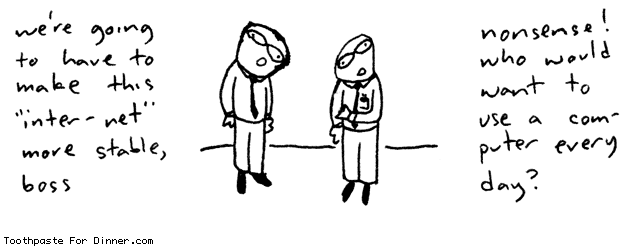
(image courtesy of ToothpasteForDinner.com)

Update! (10/09/08 @ 2:40pm) I was reading a post on The Book Bench, and found the following quote about writing by Don DeLillio:
The reason I use a manual typewriter concerns the sculptural quality I find in words on paper, the architecture of the letters individually and in combination, a sensation advanced (for me) by the mechanical nature of the process—finger striking key, hammer striking page. Electronic intervention would dull the sensuous gratification I get from this process—a gratification I try to soak my prose in.
Just more food for thought!

Wednesday, September 24, 2008

Savvy Context: Technology for the Literate and Literary

I don't remember life before the PC.

There. I've said it. I hate revealing it for fear of losing credibility, but the truth is fairly simple: I'm a 22 year old blogger and have always had a computer. On the other hand, you are reading the blog of a forward-thinking online literary magazine; you, at least, might not immediately peg me as a Gen Y baby or a traitor to literature. Here, my childhood steeped in floppy disks might lend me some authority. After all, who better to investigate the role of technology in the world of letters than someone who neither remembers life without a computer nor deny her lifelong devotion to literature?

I hope that my work here at Fringe will reveal something more personal about the relationship between technology and the written word. How ready is the individual (and the independent company) to accept the increasingly costly deluge of technology as a tool for the advancement of publishing? How effective are the gadgets and tech trends in the lives of the literate and literary? And what demands on the publishing and technology industries will writers, editors, and readers voice to mold a literate future?

TJ's links to sites of note in his first post inspired me, so I'm including my own list addressing the state of the literate nation. You've doubtless heard the buzz around at least a few of these; feel free to add your own and fill in blanks.

Next time: The Writing Process. Ideas or thoughts? Comment!