Frankly, if Pike Place Market weren't such a major tourist attraction, I would assume that he had never been there and had, at best, read that horrible corporate motivation book the fish throwers released. The trouble begins in the first stanza with the lines "Puget Sound sounds astound / no one for the crowd is pressed." The poet needs to describe those sounds for them to be meaningful; if he wanted to dodge that responsibility, he should have called them ocean or sea sounds, since the use of a name instead implies something unique about it. The pun on Sound does not ameliorate this. Had he managed a truly remarkable description, I might have been willing to forgive him for not realizing that, no matter the behavior of the crowd, the Sound would have to be unusually loud for anyone in the market to hear it given the ambient noise of the city and the distance from the water.
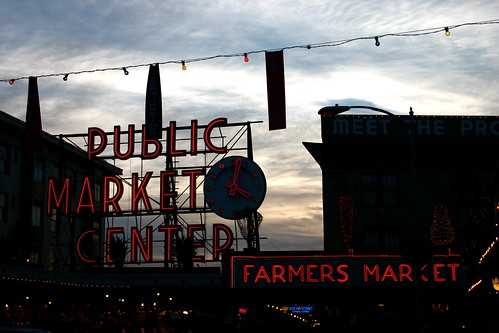 From here, Shankar goes on to describe the "fishmongers" in cliché terms as "sinewy" and "young". Even their movements are non-individualized. They cut the fish "with an efficiency of motion". He says they give out "coral nubs of salmon / jerky", though even this vegetarian knows there's a huge difference between hard (let alone coral hard), dry jerky and soft fresh fish. He accuses them of "wisecracking the entire time" but gives the reader none of their words. He tells the reader that they are "minor stars in their own minds." The prepositional phrase implies that they are puffed up, though certainly the "rapt" crowd Shankar has described should support their own estimation. It further suggests that the speaker, not specifically differentiated from the poet, considers himself superior to, or at least more clear-sighted than, these men.
 The next two stanzas read as exposition lifted from some book describing "Seattle’s oldest market" Shankar conscientiously lists specific "edibles / . . . treated like art objects" but fails to give any life to these descriptions.
Then the poem jumps into what I assume Shankar believes is the most important part: the description of what happened to Japanese-Americans who owned fish stalls when they were forced into internment during World War II. Unfortunately, this too remains vague. We get the title of the order that led to their incarceration but not the names of the people themselves. Had Shankar earlier given better details, remembered or imagined, of the present-day market, he might be able to connect them much more smoothly and powerfully to the stories of Japanese-Americans (even if he had to make up a family and research the names on baby-name websites) instead of using, for a transition, the line "I wonder how many remember", which oozes with smug superiority.
After that, he gives descriptions of shoppers and ferry boats which carry a fair bit of detail. I suspect, given their place in the structure, that they were supposed to resonate ironically with the words about the internment of Japanese-Americans. As there were no real details to hold onto in those words, however, these later lines fall flat.
Finally, he ends with what has to be the oddest line in the whole poem: "I haven’t seen a single Asian all day." Has this man ever been to Seattle? Had he just been hanging out in Packwood all day before driving in to visit Pike Place? The lie is almost big enough that if it had come at the end of a strong poem, it might have had a formidable effect—that of a metaphor or remembrance of history getting in the way of seeing reality. At the end of a vague weak poem, however, it feels like the last thrash of a drowning victim.
This shows how even a potentially powerful idea cannot thrive unless the poet pays attention and remembers or is willing to risk a dramatic, detailed lie. I did not write this to pick on Shankar. For all I know, this poem may represent a rare lapse on the part of a highly skilled poet. We all write bad poems. I've thrown away more poems in a single year than most of you reading this will compose in a lifetime. I wrote this criticism because I want people to see how damaging failure to observe and remember or imagine precisely and without fear can be.