Friday, November 7, 2008

Online Poetry: Observe, Remember, Imagine

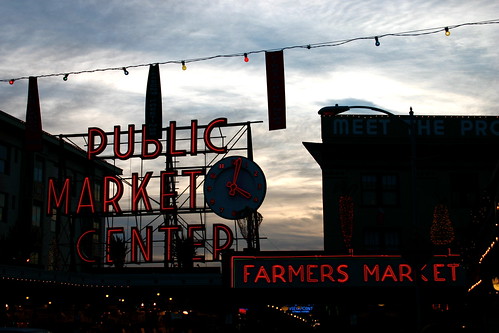
Writers should keep their senses open at all times, remember what those sense receive (even and especially when that information is not fully understood), and when in the process of writing they find they have forgotten something, they should make up resplendent lies, details more real than the real. A vague bluff will always be called. Ravi Shankar's Pike Place in Studio Vol. 2, Issue 1. Unfortunately, it does so not by demonstrating the results of such actions but by illustrating the sort of lackluster verse that appears in its absence.

Frankly, if Pike Place Market weren't such a major tourist attraction, I would assume that he had never been there and had, at best, read that horrible corporate motivation book the fish throwers released. The trouble begins in the first stanza with the lines "Puget Sound sounds astound / no one for the crowd is pressed." The poet needs to describe those sounds for them to be meaningful; if he wanted to dodge that responsibility, he should have called them ocean or sea sounds, since the use of a name instead implies something unique about it. The pun on Sound does not ameliorate this. Had he managed a truly remarkable description, I might have been willing to forgive him for not realizing that, no matter the behavior of the crowd, the Sound would have to be unusually loud for anyone in the market to hear it given the ambient noise of the city and the distance from the water.
From here, Shankar goes on to describe the "fishmongers" in cliché terms as "sinewy" and "young". Even their movements are non-individualized. They cut the fish "with an efficiency of motion". He says they give out "coral nubs of salmon / jerky", though even this vegetarian knows there's a huge difference between hard (let alone coral hard), dry jerky and soft fresh fish. He accuses them of "wisecracking the entire time" but gives the reader none of their words. He tells the reader that they are "minor stars in their own minds." The prepositional phrase implies that they are puffed up, though certainly the "rapt" crowd Shankar has described should support their own estimation. It further suggests that the speaker, not specifically differentiated from the poet, considers himself superior to, or at least more clear-sighted than, these men.

The next two stanzas read as exposition lifted from some book describing "Seattle’s oldest market" Shankar conscientiously lists specific "edibles / . . . treated like art objects" but fails to give any life to these descriptions.

Then the poem jumps into what I assume Shankar believes is the most important part: the description of what happened to Japanese-Americans who owned fish stalls when they were forced into internment during World War II. Unfortunately, this too remains vague. We get the title of the order that led to their incarceration but not the names of the people themselves. Had Shankar earlier given better details, remembered or imagined, of the present-day market, he might be able to connect them much more smoothly and powerfully to the stories of Japanese-Americans (even if he had to make up a family and research the names on baby-name websites) instead of using, for a transition, the line "I wonder how many remember", which oozes with smug superiority.

After that, he gives descriptions of shoppers and ferry boats which carry a fair bit of detail. I suspect, given their place in the structure, that they were supposed to resonate ironically with the words about the internment of Japanese-Americans. As there were no real details to hold onto in those words, however, these later lines fall flat.

Finally, he ends with what has to be the oddest line in the whole poem: "I haven’t seen a single Asian all day." Has this man ever been to Seattle? Had he just been hanging out in Packwood all day before driving in to visit Pike Place? The lie is almost big enough that if it had come at the end of a strong poem, it might have had a formidable effect—that of a metaphor or remembrance of history getting in the way of seeing reality. At the end of a vague weak poem, however, it feels like the last thrash of a drowning victim.

This shows how even a potentially powerful idea cannot thrive unless the poet pays attention and remembers or is willing to risk a dramatic, detailed lie. I did not write this to pick on Shankar. For all I know, this poem may represent a rare lapse on the part of a highly skilled poet. We all write bad poems. I've thrown away more poems in a single year than most of you reading this will compose in a lifetime. I wrote this criticism because I want people to see how damaging failure to observe and remember or imagine precisely and without fear can be.

Thursday, November 6, 2008

Savvy Context: Odds and Ends of Writing Media

Alright, some last words on why you write on computers or on paper.
On the whole, I prefer writing on paper. I have to put something down everyday. I keep a journal so that even if I'm not working on something, I have an outlet. For me it's not just the paper that's addictive because I also have a slight addiction to fancy, colorful pens.—Kandi H.
[After considering that others might not understand her process]…that is writing, I guess. The experience is different for everyone..-- Aimee L.
…I type things that enter my mind with great speed, leaving no time to process what I'm writing as I write it and to, thus, create more to continue on….I write briefly and stop for several minutes, watching the blinking text cursor rhythmically taunt and jeer me as I try to think of what comes next. When I write by hand, the process is slower and capable of marinating in its own juices. I recommend both paths--handwriting and typing, especially since the latter has spell-check--for the reasons previously stated.—Lynz M.
I think computers have made it easy for a lot of bad writing to get out there - bigoted blogs, formulaic novels, inaccurate reporting - all rife with punctuation and grammatical errors…Overall I think computers have helped writing - but please don't get me started on e-books.—Tanya P.
As much of a techie as I am (I almost never write on paper), I still can't imagine writers giving up on paper in the foreseeable future. And as content creators, writers are just as valuable in the transition to all electronic formats as the readers are important as content consumers. So we're all in agreement: you can't cut paper out of the writing game just yet. Will we ever be able to?

Teh Internetz: Teeny Tiny Laptops


This post and my next post were written far in advance and set to post automatically. As I shared last time, I am deep in the throes of NaNoWriMo and cannot be bothered by things like blogging and eating.

So as I write to you from the distant past of October 29th, when we still don't know if the election is going to have a "hiccup" or not, if Palin will suddenly grow bat wings and attack elite gay socialists, or if the war in Iraq will ever stop, I bring a sense of charming naivety.

Today I will discuss very small laptops, because I just bought one and I sort of want to gloat about it? In order to maximize my on-the-go writing time, I decided to invest in an ACUS eee PC. Mine is green, like the one pictured, weighs 2 lbs., and runs on Linux. For the ungeeky, Linux is an open-source computing platform. It's like Windows except free and crowd-created and moderated. It doesn't do everything that Windows or a Mac could do, but it is pretty nifty. And since I'll just be using this as my ultraportable, I don't need it to do much besides connect to the internet and type.

But for those writers that need more OOMPH from their mobile writing gadgets, here are some options:


    The ultra-thin, ultra-sexy Mac Book Air is pretty, but lacks the usefulness you'd like in your amazingly expensive Apple product.

    Looking slightly less hot but a better marriage prospect is the Fujitsu Lifebook.

    The Lenovo ThinkPad line consistently gets good reviews on everything from endurance to memory to battery life.

    But if you need something cheaper, take a look at what's available in Under $600 Land.

RIP Michael Crichton


The prolific doctor turned author Michael Crichton died yesterday. Though perhaps not the most "literary" of writers, his work was suspenseful and thought-provoking.

Tuesday, November 4, 2008

VOTE


Be a "real" American. Get out to the polls today.

Monday, November 3, 2008

The Relevance of Rexroth


Walking in Greenwich Village a few years ago, I saw a small historical plaque affixed to the building where Dylan Thomas died, having drank himself into oblivion. What was one poet's reaction? The poem "Thou Shalt Not Kill".

Has anything changed? Today Brooklyn, home to Whitman, is a bastion for writers. Denver, too, is home to writers and the magazines that promote them; no longer does it bear Ginsberg’s “Denver Doldrums.”

Chicago, too, is experiencing a renaissance--at least if one can measure it via the poets circulating through, orbiting poets like Joshua Marie Wilkinson whose Rabbit Light Movies film many of these poets passing through. Aside from Poetry magazine and Carl Sandberg, even beyond the Chicago Review and other presses, who knows the literary history of Chicago?

Read An Autobiographical Novel, a stunning text by Kenneth Rexroth and an invaluable document of the era just before the Depression in Chicago. Rexroth writes about the urban Midwest with so much detail, with such panache, it’s been said his book will make your own life seem morbidly dull.

In its heyday, Chicago was home to anarchists, communists, agitators, artists, and writers. Rexroth throws around names no one would recognize today. Sure, he lived in New York, too, and beneath Hart Crane’s apartment no less, where young “Rex” could hear Crane playing his blues records while writing White Buildings. But Chicago! Who would have known how much had happened there in theater, in painting, and in the response of labor movement crowds to poems read on street corners and soapboxes?

Jacket Magazine features a tribute issue to Rexroth, including an essay by Sam Hamill, a excellent introduction to a profound influence on an entire generation of poets, especially “the Beats” whom he had little patience for. Rexroth’s influence in San Francisco is what we generally attribute to him, especially acting as MC for the Six Gallery Reading, and also for his “basement readings” with Lawrence Ferlinghetti.

Aside from a recent issue of Chicago Review devoted to him, and the release of his collected poems by Copper Canyon Press (edited by Hamill and Bradford Morrow), and even a website, the Bureau of Public Secrets, featuring generous portions of his work, is his legacy somewhat neglected? Perhaps not.

Having read nearly all of his books—which include not only poems but his magnanimous essays—I’d like to suggest a return to a deeper study of his formidable intellect, his model of the life well-lived, his astounding recollections of American history, and the deep and compassionate understanding of the human condition.

(See a video of Rexroth reading his poetry here and another blog entry here.)

Sunday, November 2, 2008

Fear His Wrath... or don't... maybe

Ah, the power of the media: post an idea in the ‘comment is free’ section of a national newspaper’s website and watch it grow. Or in the case of Ariane Sherine, you can also watch the public falling over each other to pledge their pennies towards your humble cause.

Sherine wanted to raise £11,000 in order put an atheist message on no less than 30 London buses for 4 weeks – the rationale being to counter all the damnation-style religious advertising that plague public transport (something, I must admit, I have been blissfully oblivious to). After enrolling the British Humanist Association, plus everyone’s favourite anti-God spokesman, Richard Dawkins (who promised to match whatever the public throws in – but only up to £5,500) Sherine has already amassed a healthy £115,820.10.

I’m not quite sure what to make of it all. Part of me thinks ‘fair enough’ and another part is left wondering, as you always do with such matters, whether all those lovely pennies (and the formidable power of the public forum) could be put to better use. Much has also been made of the phrasing of the ad, said to make its debut in January. What will it achieve? I can’t imagine a mini-ambush of atheist buses will weald significant influence over commuters, but I suppose in light of all the lovely debate it’s inspired, the ad itself is almost incidental. Interestingly, theologian think-tank Theos has also donated £50, under the reasoning that, hey, at least it gets people talking. It’s all publicity, innit.


A more eloquent (and informed) take on it all.