Showing posts with label historical fiction. Show all posts

Wednesday, December 10, 2008

The Wednesday Wars-- A Minor Literary Campaign


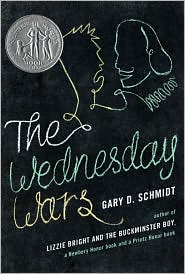
Meet 13 year-old Holling Hoodhood: the only son of the only Presbyterian family in a neighborhood divided by Jews and Catholics. In other words, he’s the only kid who has to stay behind with his teacher on Wednesday afternoons while the rest of his classmates go to Hebrew school or Catechism class in Gary Schmidt’s 2007 Newbury Honor book, The Wednesday Wars.

The novel's title is inspired by Holling’s insistence that his English teacher, Mrs. Baker (who is a little testy, thanks to her husband’s serving in the Vietnam War), hates his guts, because she now has to spend her Wednesday afternoons alone with Holling, instead of enjoying afternoon tea with the her “Wives of Vietnam Soldiers” club. Holling’s proof that she hates his guts? In addition to assigning him such lowly tasks as banging erasers and cleaning the cages of Sycorax & Caliban (the class’ pet rats), she also forces him to read and perform Shakespeare (the horror)!

To complicate things further, Holling’s troubles do not end with Mrs. Baker. On the home front (better known as the “Perfect House”), he is forced into playing the unwitting peacemaker in battles between his budding flower-child sister, his stereotypical 1960’s housewife mother, and his overbearing, small-business owning, Walter Cronkite-loving father.

The novel progresses in a predictable manner, with Holling eventually coming to realize that not only does Mrs. Baker not hate his guts, but that there is actually more to her than he initially thought. Same goes for Shakespeare. The slapstick comedy scenes (think, “American Pie” for ‘tweens), is balanced by sobering reality checks from the Vietnam War. The end of the novel, though expected, is just the right combination of silly and sentimental to save it from the banality with which it dangerously flirts.

All in all, the book just didn’t do it for me (making me really wish I had read this book before I agreed to make it a part of my 6th graders’ curriculum). But, if you’re looking for a quick read, a few chuckles, and a good message, The Wednesday Wars will deliver--no Post Traumatic Stress Syndrome strings attached.

Wednesday, October 1, 2008

Fever-Stricken


Laurie Halse Anderson is one of the most gifted young-adult authors of the 21st century. Her 2nd published novel, Fever, 1793 tells the story of 14 year-old Matilda Cooke, strong-willed heiress to her widowed mother’s coffeehouse in post-revolutionary Philadelphia, and is a quintessential example of the higher-standards required of today’s young adult literature (R.L. Stein, take note).

For the history lovers, there are the historical names, places, and details of the worst yellow fever epidemic in U.S.history intricately woven into Mattie’s story. There’s the dry-heave-inducing accounts of yellow fever’s symptoms. There’s a sweeter-than-saccharine romance between Mattie and Nathaniel Benson, a ne’er-do-well, lowly painter’s apprentice in front of whom Mattie scandalously dares to show off her elbows (gasp!).

There’s Grandfather: General William Farnsworth Cooke “of the Pennsylvania Fifth Regiment,” who spends his days in the coffee shop, regaling the customers with stories of his days under General Washington, while doting on Mattie and his pet Parrot, “King George.” There’s Eliza: the Cooke family’s freed-slave chef who serves as a member of the Free-African Society and always shoots from the hip (“You’re too soft!” she tells Mattie, “You have city hands and a weak back. You wouldn’t last a week on the farm.”)

And, of course, there is Mattie, a typical teenager grappling with the woes of adolescence: awkward in her pubescent body, rebelling against her stoic mother’s rigid expectations while simultaneously seeking her hard-won approval, and trying to establish her own identity, under the most tumultuous of circumstances.

The novel begins with a sluggish introductory chapter which sets the scene and introduces the major characters, and through which I always have to coax my dubious students. But, by the end of chapter two, the story is catapulted into high-gear as it races towards the heart-wrenching climax (I am yet to make it through a read-aloud without tears), and a conclusion that leaves no loose ends untied as Anderson deftly concocts a well-balanced literary meal that is at once educational, suspenseful, and deliciously satisfying.