Saturday, January 31, 2009

Hello, Mr Updike by Stacey Richter (Part IX)

Pushcart prizewinner and perennial Fringe girl-crush Stacey Richter had this to say:

When I was growing up, my parents had a small but incisive collection of the highbrow fiction of the day. I remember staring at their shelves and seeing hardbacks by Joseph Heller, Saul Bellow, John Updike, Phillip Roth, and John Cheever, whose novel Falconer didn’t move from its spot on the living room coffee table for three years. We lived in the deep suburbs, with no bus service, before cable and VCR’s. It’s hard to describe how boring this was; it was sort of like a sensory deprivation chamber with a television in it. Given the time on my hands, it’s not surprising that I eventually read or tried to read every book in my parents’ library. I remember tackling Giles, Goat Boy when I was thirteen and The Complete Stories of John Cheever at about eleven. But I could never penetrate the shelf full of the guys I eventually came to think of as the self-loving males of the mid-twentieth century: Bellow, Updike, and Roth. Their books made me feel creepy. I sometimes picked them up and read a few chapters. They were about men; they were about men driving around. They were about insecure, tortured men driving around, looking at women. And even when the subject was youth it still seemed like the subject was middle age: families, jobs, philandering, divorce. Where was the magic? It was weird. I gave up and reread “The Enormous Radio.”

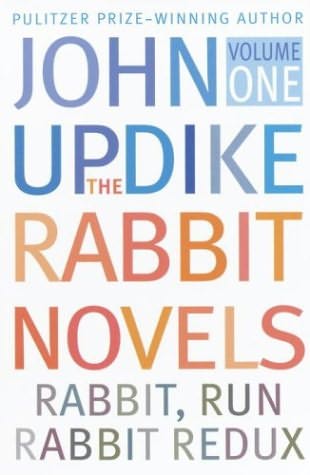
A few years ago, I decided to try again. I love embarking on reading projects and I was beginning to feel stupid for having skipped the self-loving males of the twentieth century (not Cheever—I didn’t skip him.) Mostly I read Mailer, Bellow, Roth, and Updike, and of those, I ended up reading the most of Updike because I read the four Rabbit books. I didn’t like Rabbit, Run, but by the time I had finished the quartet I realized what a remarkable project it was: the whole, imagined life of a character, a running document of the times, and it forms a thematic whole. Awesome! What ambition! What’s more, they’re funny, dark, and written with what seems to be an amazing inborn facility. Even the driving around passages were great—essential, even—and I hate driving around passages. But what I liked most about them is also what I hated initially: I came to realize that these books were a chronicle of my parents’ generation—especially the white, middle-class men who were too old to be baby boomers but were still affected by the sexual revolution of the sixties. No wonder I found these books creepy. No teenager wants to read about the inner lives of their parents’ contemporaries—this would suggest that their parents had inner lives. But in the end, that’s what I came to appreciate most about Updike and the other self-loving male writers of the mid twentieth century (who I realized were actually the self-loving/self-loathing writers)—that they were my parents’ contemporaries. Updike was the same age as my father. It makes sense that he would write about suburban life with affection and loathing, and enshroud his characters in entitlement and shame: I see these oppositions in my father’s life, and in the lives of his friends, men who were born into an era when they enjoyed a great deal of privilege (at least compared to women and minorities), and saw that privilege slowly leak away.

Updike was particularly obsessed with chronicling the social movements of his time, and I’m grateful to him for giving me a window into the struggles of my parents. I was especially saddened to hear of his death because I associate him with my father (still alive!) and because there was a little magic for me in Updike after all. Several years ago, I saw a real estate sign with the broker’s name on the bottom: John Updike. I pictured Updike holding an open house, and then I thought how great it would be to go around stenciling the names of great American authors on the bottom of all sorts of real estate signs: Great Floor Plan, Saul Bellow; Open House Cancelled: Joyce Carol Oates. When someone mentioned that Updike really did have a house in Tucson, I assumed it was the real estate Updike and not the genuine one. But I checked the tax records anyway (I’m a pretty good web-stalker). As it happens, there are many John Updikes in the world, and many in Tucson. But there’s only one who also has an address in Updike’s small town of Beverly Farms, and he does indeed own a condo in a golf community in the Tucson foothills. Since then, I sometimes like to pretend that I’m about to run into Updike in Trader Joe’s. I’d be the only person in Tucson to ever recognize him, and I’d just happen to have a copy of one of the Rabbit books with me for him to sign. Like all the old guys, he would be buying fourteen packages of frozen blueberries, and like all the old guys—my father included—his wife would be with him, giving orders and pawing through the salmon.

“Hello Mr. Updike,” I’d say, “it’s so nice to see you.”

Friday, January 30, 2009

Weighing in on Updike Part VIII-- A Post by Chip Cheek

Fringe contributor Chip Cheek was surprised by how he felt in the wake of Updike's death:

I know John Updike through his short stories and the many dozens of essays and reviews I read of his in The New Yorker and elsewhere. For me, as a writer, he’s a hero not so much for his actual writing — although wow, he could write — but for how he wrote: honestly, thoroughly, plentifully. 

He was and will remain an easy target for any number of artistic, political, and personal factions. His style is too florid. His subjects are too small. (He was a minor writer with a major style, as Harold Bloom said.) He never understood women. He wasn’t progressive enough. He took up too much space in The New Yorker which might otherwise have gone to budding young writers like myself. He was so white. But Updike was genuine; he was dedicated, I think, to setting down in his work, as thoroughly and honestly as he could, the world as he saw it and felt it, and his sentences bowed under the weight of all he observed and felt compelled to record. 

He was a smart guy who matured amid the cultural upheavals of the second half of the past century, and he was conflicted by it all, as any human being would be — as he himself admitted. Lesser writers might have polished their prose in accordance with fashion, but not Updike, and it took courage to write as he did because, as he surely knew, he would reveal his own limitations and prejudices. But he wasn’t afraid to enter the conversation; he wasn’t afraid to get it all down. David Foster Wallace said disparagingly that Updike never had an unpublished thought, but there’s something to admire in that, too. 

I miss you, John Updike. Frankly, I’m surprised how much I miss you — but man, I really do.

Weighing in on Updike Part VII-- A Post by Sarah Einstein


Former Contributor Sarah Einstein shares her own very special memory of Updike:

John Updike introduced me to the concept of fellatio at the tender age of seven, when I stole Rabbit, Run from my mother's bookshelf. I didn't understand much of the book, of course, but knew that there was something fairly dirty going on. I asked my mother about it, and was given a copy of one of those sex-for-children books illustrated with vague watercolors of two peach hazes intertwined on the page and phrases like "make a baby" and "the mommy and the daddy." She moved all of her books with smutty bits to a higher shelf. I, of course, just found a chair.

Weighing in on Updike Part VI--A Post by N.S.R Ayengar


In Part VI of our series, Professor N.S.R. Ayengar writes:

Madras

30th Jan 09


John Updike, the most vociferous spokesman of the American ‘culture-war’ of the sixties, regrettably passed away on the 27th Jan at the age of 76. With his passing America has lost a luminous star from its literary firmament. Whatever his detractors may say about his obsessive depiction of sex – the unmitigated, lurid details of sex, especially that of female, his description of marital infidelity (which of course are the mainstay of majority of his novels as well as that of the famous five Rabbit novels), one cannot deny that he was one of America’s greatest prose stylists. He created a style which was effortlessly fluent, polished and mellifluous, almost bordering on poetry. Much of his obscenities get glossed over by his immaculate prose style and that also explains why his readers have tolerated him. But for his stylistic excellence, his books, perhaps, would have degenerated into cheap pornography.


Updike is often dubbed as the chronicler of “suburban adultery” – a fact which he never made any secret about. He once wrote that it was ‘a subject which if I have not exhausted , has exhausted me’. Yet on occasions he shunned his familiar territory and explored pastures green in such novels as: The witch of Eastwick(1984), The Coup(1978)- (about a fictional cold war - era African dictatorship), which were best sellers and showed the author at his Nobokovian best. In 2000 he wrote a carefully crafted and researched post- modernist novel on the story of Hamlet- Gertrude and Claudius. His other works like The Centaur,(the winner of National Book Award 1963) Couples(1968) and Roger’s version(1968) were extremely popular so much so that they won the author a place on the cover page of Time Magazine and brought him fortune.


Updike celebrated the ordinary American. He was the champion of the middle class. In an interview to Time Magazine(1966) he said “my subject is American protestant small- town middle class”. Yet he so admirably transformed the ordinary into something artistic by his supreme artistry.


In most of his novels one can detect an unconscious and unstated theme i.e the irrefutable correlation between unbridled promiscuity(unrestrained sex) and death. Therefore, though Updike inundates the readers by a hypertrophy of sexual imagination, the readers know where to stop. This need not preclude us from appreciating his greatness as an artist.

Thursday, January 29, 2009

Writing Under Stress


Several weeks ago, two days before my twenty-fifth birthday, I was struck by a case of appendicitis and had to undergo an emergency appendectomy at Maimonides Medical Center in Brooklyn. I had never been hospitalized before, had never even broken a bone before (though I suffered a nasty sprain resulting from a too-spirited game of Wii Tennis).

Before you get all freakily concerned, I'm fine. Appendectomies are like the bean burrito of surgeries: you can't really mess one up, and the professionals have probably done thousands of them in their careers. Going under the knife (or rather, the tiny little instrument they now use) didn't bother me as much as the fact that everything was taking place, in my mind, in sort of an abstract sense.

I experienced it not as, I think, a normal person should experience an illness. Or maybe it is and I just never had a chance to find out before now. But my mind was stuck seeing things as if I was jotting down mental notes for Chapter Five of a best-selling memoir. I couldn't remember for the life of me what the name of my nurse was or who I had given my insurance card to or where I'd dropped my blood-soaked backpack (an IV needle went badly during admittance). I could only remember really, really good imagery and symbolism, metaphors and morbid jokes.

I recall vividly the old woman, stuck in the ER hallway with me, beating the metal railing of her hospital bed with her red velvet slipper and shouting "I need help! I have a terrible pain!" over and over while everyone ignored her.

I remember drifting off to sleep while waiting for a CAT scan, only to be woken up by an old man vomiting blood into a small blue plastic tupperware at my elbow.

I know for sure that before I went under, the surgeon said to me, "Boston, huh? Just think: if it'd only been a few months earlier, you might be getting this surgery at Harvard. But now you're at Maimonides!" He seemed to think was fantastically bad planning on my part. (It is a testament to the amount of pain I was in, I guess, that I didn't bother to point out the nonexistence of The Harvard Hospital.)

But I can't remember what my last thought was before they snuffed me out, or who was with me when I woke up, or what they had dressed me in and at what point. Important, applicable facts escape me. I was only interested in writing my memoirs.

After a miraculous recovery that I attribute to my relatives force-feeding me bacon and cream-based soups, I can't help but wonder if all the things I'm experiencing in my life are viewed through this delusional lens of Writer. Historian. The Hero of Our Tale. What arrogance is this, that I refuse to remember what plan my health insurance is, but I expect my rendering of a red velvet slipper smacking against metal to somehow be of importance to someone else?

As with most of my existential crises, this one was solved in a homosexual way. I had volunteered with SAGE (Services & Advocacy for GLBT Elders), and they've decided to put me to work on a project, along with tons of fantastic and talented writers, to collect my elders' life stories and write them up in a book. It's an exciting project that could go in many different directions, and it serves to remind me that I am not my own best character. I am not the hero of this memoir (that doesn't exist and probably wouldn't get published if it did). The best characters are the people around me, and I need to be concentrating on their stories.

I guess this post has a moral? I am sorry about that. Here, have a picture of a cute kitten.

Weighing in on Updike Part V-- A Post by Zehra Khan


Fringe art contributor Zehra Khan remembers John Updike in her image, Rabbit Redux (Watercolor on monotype, 2009).

Weighing in on Updike Part IV


Let me start off with a confession: I have never read a John Updike novel. Despite this deficiency, he remains in my mind as one of the most, if not THE most, prolific literary writers of our time, standing shoulder to shoulder with Joyce Carol Oates and Philip Roth, giants of American literature.

Updike's "A & P" was the first short story we read in my freshman year composition class in college, and I still remember reading his description of Queenie, the pubescent temptress who slaps barefoot into the local A & P to change Sammy's life forever: "With the straps pushed off, there was nothing between the top of the suit and the top of her head except just her, this clean bare plane on the top of her chest down from the shoulder bones like a dented sheet of metal tilted in the light. I mean, it was more than pretty." Sure, he was a classic "man's man" writer (just a paragraph before, Sammy wonders parenthetically if girls really have a brain or if it's "just a little buzz like a bee in a glass jar"), but his deft use of language and tone more than made up for the often less-than-favorable portraits of females in his stories (taken with a grain of salt, as usual).

In my first grad school literature course, we read "Pigeon Feathers." I don't remember what other stories we read that week, but I do remember it was a decidedly more concise writer that our teacher contrasted with Updike's winding and dramatic story on God and the nature of mortality. I was the only one in the class who preferred Updike's style--I appreciated the lyricism of his language, and how he used it to illustrate larger issues that hulk in the corner of all of our minds.

I'm not the only one who remembers Updike fondly. For more remembrances of the author, check out these tributes:
Vernacular
NPR
The New York Times
Los Angeles Times
the New Yorker
the Guardian
the San Francisco Chronicle
the Chicago Tribune

Wednesday, January 28, 2009

Weighing in on Updike Part III--A Post by Scott Votel


In Part III of our series, Boston-based writer Scott Votel remembers John Updike:
One gets the sense that Philip Roth is uniquely alone today. With the death of John Updike, Roth now exists as the sole student of a certain school of masculine fiction that produced Bellow, Cheever, Yates, Mailer, Kerouac, and Salinger. While Roth surpassed John Updike long ago as the inventor of necessary and ingenious fictions, Updike remains a vital figure in American literary history. For perhaps too many readers under the age of 40, John Updike was easily dismissible: a near unrepentant chauvinist, a "non-hawk" who supported the Vietnam War, a prolific chronicler of white middle-class suburbanites, a linguistic show-off. Despite his suspect ethos, Updike was, at the elemental level of the sentence, one of the best writers in English. His only real rival as a stylist was Nabokov.

Studiously reading his work, one is nagged with the idea that Updike had literally seen everything, remembering it all enough to pen volumes filled with dazzling descriptions and disquieting metaphors. There's the transcedently quiet moment between two strangers in "The Happiest I've Been." Updike describes their conversation by noting "the quick agreements, the slow nods, the weave of different memories; it was like one of those Panama baskets shaped underwater around a worthless stone." Or, there's the fire in "Wife-Wooing" (from the uniformly excellent Maple stories collected in Too Far to Go): "A green jet of flame spits out sideways from a pocket of resin in a log, crying, and the orange shadows on the ceiling sway with fresh life." Or, the cabbage from "Sublimating": "the pure sphericity, the shy cellar odor, the cannonball heft." These sentences, plucked quickly from a candidate pool of hundreds of other ravishers, are the foundation of a career that carefully examined the depths of suburban ennui. As a literature, we need these sentences not because they expose the internal collapses of a privileged class but because they show us what malleable toys we have in our collective dictionary.

Mike Heppner's Novella Series (Third Installment)

When asked if he would recommend self-publishing to writers who want to get the word out about their work, Heppner explained that he already had a foundation as a published author. He questions whether the Internet is a useful enough tool for writers who don’t yet have credentials; however, the attitude toward being published on the Internet has changed drastically in the last ten years. But the problem with making yourself stand out online is the same as “getting out of the slush pile [of other writers]. How do you separate yourself from that?”

For starters, give your readers a voice. In his cover letter accompanying Man, Heppner invited readers to send their feedback, which he would then post on his website. The curious thing is that Heppner is getting more honest feedback and goodwill now than he did in his old school publishing days (e.g., comments on his novels on Amazon). He believes the difference is because readers have an inherent distrust of corporate media that could rest on an author’s shoulders. One Man reader wrote:

My friend J gave me a copy of Man over midnight ice cream, and I read it the next day. I applaud your experiment…I've dabbled in writing for the last four or five years and I know exactly what it feels like... We have to remember that the worthwhile part is intangible, is what's going on in our own heads and lives.

While Heppner wouldn’t call these types of “self-releases” of his work ideal, he thinks it’s better than having it sit in a closet. He likes working with editors and would like to get back to traditional publishing, but he feels that the publishing industry is "so slow moving." Heppner was able to release the novellas every 3-4 months and the process allotted him much freedom and creativity in engaging readers. He is currently working on his next novel entitled Quartered.


For you lucky New Yorkers, Heppner will be reading at the KBG Books on 2/ 27. The rest of us can go to www.mikeheppner.com or www.smallanchorpress.com to learn more.

Tuesday, January 27, 2009

Weighin in on Updike, part II -- A post by Sarah Zucker

As many of you have heard, prolific American author John Updike died today. In this series, we ask Fringe contributors to remember a literary legend. Sarah Zucker is the second to weigh in:

John Updike is usually most well-remembered for his novels, which I have admittedly not read. His poetry, however, was crucial to my understanding of the inner-connectivity in the world around us. The Banal and the Sacred co-habitate within his poems seamlessly, and he speaks with a voice so familiar, so modern, that it shakes your core to recognize the deep truths within.

Currently, I am a dramatic writing grad student at NYU, and I started on this path during my sophomore year of college, largely thanks to Mr. Updike's influence. Someone read aloud to me his poem "Dog's Death," at a time when I was plagued with illness for nearly a month, and it struck me to my very core: A simple little story about a man and his dog, laid out to explicate a truth of existence. I wrote my first screenplay borrowing that poem, and the experience, and the script itself, have gotten me to where I am today. Thank you, Mr. Updike.

Weighing in on Updike--A post by Tom Conoboy


As many of you have heard, prolific American author John Updike died today. In this series, we ask Fringe contributors to remember a literary legend. Tom Conoboy is the first to weigh in:

John Updike has died. He was a great writer, whose early works will remain outstanding works of literature. In particular, The Poorhouse Fair is as ambitious and interesting a first novel as it is impossible to imagine. In it, the young Updike settled himself into the characters of a host of old and dying inmates of a poor house, and discussed life and death, Christ and and humanity, with a wisdom which is simply extraordinary in one so young.

Updike lost his way in latter years, and those novels, with their relentless focus on sexual relations, lost something of that essential human beauty that occupied his earlier works. I will remember him for The Poorhouse Fair, The Centaur, and Rabbit, Run. A more extraordinary trio of novels with which to begin a career it is difficult to imagine.

This is his character Hook speaking in The Poorhouse Fair. As an atheist, I can't accept these words, but I suspect they were close to the views of Updike himself, and I quote them now in the memory of a man who believed, not only in his God, but in the goodness of humanity, too:

'There is no goodness, without belief. There is nothing but busy-ness. And if you have not believed, at the end of your life you shall know you have buried your talent in the ground of this world and have nothing saved, to take into the next.'

Lorrie Moore's writing broke my heart, in a bad way.

I've long been a fan of Lorrie Moore's short stories. If you haven't had the opportunity to read her work, I'd recommend it. She's funny, smart and cynical, which are my three favorite adjectives. Also, she often writes stories about interesting female protagonists of the funny, smart, and cynical variety.

If you're interested in podcasts and the like, you can listen to Louise Erdrich and New Yorker fiction editor, Deborah Treisman read and discuss a Lorrie Moore story here.

So, I was greatly disappointed when I read her novella, Who Will Run the Frog Hospital?, which I found largely whiny and flat. Lorrie Moore is an author whose voice I identify with so strongly and whose characters I often wish were real people so I could befriend/think I'm already friends with. Because of this (unhealthy) relationship I have to her work, I felt strangely betrayed by this novella.

Readers, have you had this experience with an author? Please share!

Monday, January 26, 2009

Delegation or diplomacy?

Beat the slush pile! It’s every unpublished writer’s dream, no? The world is changing: get ready to wake up to your new reality...

We’ve all heard the horror stories of bored work-experience kids being handed your masterpiece – what if they overlook your skill? What if they’re so overwhelmed and overburdened that everything they read disintegrates into mediocrity, or, even worse, utter shite? Well, in this wonderful age the aloof and inaccessible world of publishing is opening its iron doors and letting everyone pitch in. Thomas Nelson started gifting books to bloggers willing to write a review, and now, Harper Collins have created their very own online slush pile, available to anyone willing to create an account whore out their wares.

The premise is simple: upload your novel and let the masses decide whether it’s worth printing. This is more than delegation, my friends; this is a community. Never feel alone and unloved again; build up a snazzy fan base; get people talking, bask in the buzz.

So will it work? If the public get to play an active role, I suppose it’s publishing gold; after all, the people get what they want, and the publishers get their money. I’m not sure why I’m not thrilled by Authonomy (in spite of its nifty name). The discerning eye is not gifted out to everyone; this is a public (in the UK at least) who lap up shoddy celebrity memoirs, power of the human spirit mush and other titbits of cultural decay. I’ve always been a snob about such things, so perhaps I’m being too harsh... what do you guys think? Is anyone rushing to upload their novel? Or are you more inclined towards the (mildly more empowering) issuu approach? Or is anyone out there a reclusive Salinger type, penning secret wonderworks for your own pleasure?

Sunday, January 25, 2009

Freedom from the Known When the Known is Everything We Know


“How can I love what I am doing if I am all the time driven by ambition, trying through my work to achieve an aim, to become somebody, to have a success? An artist who is concerned with his name, with his greatness, with comparison, with fulfilling his ambition, has ceased to be an artist; he is merely a technician like everybody else."--Krishnamurti

I've been gorging on J. Krishnamurti, and applying it not only to my sense of being in the world (a solution which can be reduced in words to "pay attention," or as Ram Dass would have it, Be Here Now) but to my sense of myself as a writer, even a blogger.

As to my Internet presence, Krishnamurti adds this (from Freedom from the Known):

“I discover for myself that I depend on something—an audience, say, which will stimulate me. I derive from that audience, from addressing a large group of people, a kind of energy. And therefore I depend on that audience, on those people, whether they agree or disagree."

Why are we all online? Why all this publishing/blogging/yelling? Have I lost my way in ambition? As William Deresiewicz has it in his article in The Chronicle Review, the postmodern property is "visibility"; i.e., "look at me."

But why look at me? Because my opinion "matters." Because in a world where we've lost the respect given to true authorities, the result is everyone is an expert (Keith Kahn-Harris and David Hayes have an excellent article on the politics of Me at Open Democracy).

The result, of course, is a surge of Relativism (read Anthony Daniel's fine article in The New Criterion) and art that is reduced to utter Subjectivity (see Theodore Dalrymple's essay in the New English Review). Everyone, apparently, needs an audience.

And so everywhere I look is the Internet equivalent of the need to be seen, to be visible, to connect: Facebook, Good Reads, blog after blog, and so on. This is what Krishnamurti calls "stimulation," the kind that deadens the mind and kills real creativity as we grow dependent on others for validation, for confirmation of our opinion, for whatever reward the ego demands. He connects it with a move away from nature and towards urbanity:

“Most of us have lost touch with nature. Civilization is tending more and more towards large cities; we are becoming more and more an urban people, living in crowded apartments and having very little space even to look at the sky of an evening and morning, and therefore we are losing touch with a great deal of beauty…Having lost touch with nature we naturally tend to develop intellectual capacities. We read a great many books, go to a great many museums and concerts, watch television and have many other entertainments. We quote endlessly from other people’s ideas and think and talk a great deal about art. Why is it we depend so much upon art? Is it a form of escape, of stimulation?...Perhaps it is because you do not know how to look at all the things about you that you resort to some form of drug to stimulate you to see better.”

Naturally, I am fully included. Namasté.

Mike Heppner's Novella Series (Second Installment)

Utilizing “stagger promotion,” Heppner has released each novella along with hype for the next one, and building momentum, readership, and press along the road. Each part in the series has taken a different medium (released online, left at random locations nationwide, and as a published book), and readers don’t know how the next one will take shape. Heppner is exploring options for Talking—his 4th novella, coming out March 1—but would like to keep it text-based.

The four novellas aren't related by narrative and can be read in any order, “but all are concerned with bridging the divide between people who write fiction and those who read it" according to his site. The first in the series, Talking Man, was published in September ’08 by Small Anchor Press, which specializes in limited-edition chapbooks. “The Making of Talking Man,” interviews between SAP editor Jen Hyde and Heppner, follows the novella’s evolution. Man Talking, the third novella (also the first to come out) was “self-released,” as Heppner terms it, last April via his website, where it remains free to download (and has been—over 3,000 times). He doesn’t consider Man Talking as published but rather as “presented to readers.” He believes to be published means to go beyond self-editing.

Half way through his third novella, Heppner realized it wasn’t sellable due to its length. He entertained others ways to release it—from a marathon reading to the Radiohead route, seeing what readers would offer to pay. Considering the novella “a hybrid between a story and a writer’s manual,” he decided it would be “apropos” for an author’s site (which he happened to be creating at the time).


In my next and last installment, Heppner discusses his views on self-publishing and we take a look at the response to Man.

Saturday, January 24, 2009

Self-Publishing Part II: Mike Heppner's Novella Series (First Installment)


This past December Mike Heppner, author of The Egg Code and Pike’s Folly, released his novella, Man, the second in a four-part series. But you can’t purchase Man in bookstores or read it online; it has to be found. In a stunt he describes as “guerrilla publicity,” Heppner sent copies to friends across the country to distribute and leave in coffee shops, museums, libraries, and other high-traffic locations. Man has surfaced at a gym and on an airplane, and the tactic seems to be working: it has gotten a lot of blogger buzz and was mentioned in The New Yorker.

Releasing his work this way is “a public way of calling attention to the problems [in publishing]” that Heppner says can happen to anyone in the business; you don’t get long-term support and you have to make your own way. With large presses, he explains, writers are dependent on other people doing work for them. Those people are overworked and haven’t read your piece, and they put a project to bed a week after it comes out.

In response to his blurb in The New Yorker, Heppner says the key was leaking out word about the novellas to enough blogs. The Man Talking Project has been mentioned in Maud Newton, HTMLGiant, Conversational Reading, AdFreak, Media Bistro, The 26th Story and The Millions.


In my next installment, I’ll discuss Heppner’s publishing history and how the Man Talking Project came to be.

Thursday, January 22, 2009

Spread the Word(s)

While fishing around Craigslist for writing gigs, free coffee tables, and volunteer work, I stumbled across a program called Chicago Books to Women in Prison. By donating any (paperback) books to the program, incarcerated women in prisons nationwide will be given the chance to read. Their site states that they "hear over and over that rehabilitation is not a priority, and prison libraries tend to be dismal, if they exist at all."

So, as much as you love your books, (believe me ... the whole trying-to-start-a-library project is all too familiar) why not browse your bookshelves and donate to women in need? Chances are, someone who hasn't read "The Catcher in the Rye" will appreciate it more than you will the third time around. Besides, Amazon always has great deals if you can't live without it.

Here's your chance! Loosen your grip on that history book from freshman year of college and use that rainy day to see a movie instead. Come on ... who do you think you're kidding anyway?


Their blog reads:

We are still (as always) in need of:

PAPERBACK ONLY!

  1. Dictionaries
  2. Composition books
  3. Daily Meditations
  4. GED prep books, especially math
  5. Urban fiction
  6. Books on drug or alcohol recovery
  7. Yoga or exercise books
  8. Health books for HIV positive people
  9. Books on Wicca
  10. Books on racism and/or mass imprisonment
  11. Blank journals

Contact Information:
Chicago Books to Women in Prison
c/o Beyondmedia Education
4001 N. Ravenswood Ave #204C
Chicago, IL 60613

chicagobwp@hotmail.com

Happy Donating!

Monday, January 19, 2009

Living Overseas and Maid Wages

A good friend of mine used to joke that "only boring women keep clean houses," and being anything but boring myself, I have always vowed to pay someone to do my cleaning if I could ever afford to do so. But I got a rude awakening when I triumphantly posted in my Livejournal that I'm paying my new maid 500 ringgit a month for eight hours a week of labor. To see my actual cost, divide that by 3.5. When I posted that blog, I did so with the idea that my American friends would be jealous, a rare occasion because having a maid is one of the few perks of living in Malaysia. Instead, my friends informed that this 40-yr old woman will be make $4.46 an hour, making me a sweat shop slave driver. The money I am giving her is what she asked to be paid for the amount of work that she proposed to do, though, so what that amount meant hadn't entered my mind. And I have the air conditioning on with NPR's All Things Considered in the background. Surely she could do worse.

My conscience was unsettled, though, so I decided to check up on whether she's getting a good part-time wage for Malaysia. Actually, it appears that house maids are doing pretty well according to this salary guide. There currently is no minimum wage in Malaysia, but look at this article which proposes a minimum wage of 1,200 ringgits. My maid earns almost half of that for eight hours a week. If she has two other houses, she's doing better than that, and if she works 40 hours a week, she's making almost double what authorities here think is a living wage. Despite what you might think, by paying maids so highly, we are empowering these women in a market where their unskilled labor would earn far less in other sectors.

But if all of this is true, then why do I feel like I am doing something wrong? I boycotted Nike shoes and Taco Bell tomatoes back in the day because of labor abuses. Of course, my house cleaning is hardly a matter of out-sourcing U.S. jobs or paying illegal immigrants less than locals. In fact, I am paying her more because it's possible to get Indonesian girls to work for you full-time for 500 ringgits. But do I only make myself feel better by saying "Oh, but someone else is worse!" Or am I legitimately doing what any overseas employer does, which is to pay the local going rate? Methinks I doth protest too much.

Shakespeare's Monkey Revue Volume 2

Hands down, my favorite gift this Christmas was my very own copy of this winter's Shakespeare's Monkey Revue. This issue's theme is Food, and I literally savored every page. The journal does a bang-up job of mixing humor with seriousness, and whenever a piece hits a sad tone, you can find a reason to laugh on the next page.

Brent A. Fisk's Yellow Banks, Indiana, October 1978 brings the smells and sounds of a campground vividly to mind:

The thick clank of cast iron skillets, scent of coffee
sausage and eggs. The lemon of hickory leaves.
I dragged myself from wool blankets,
flannel sheets to find an idle lap.


And the casual, friendly tone of David Hirt's Douglas of Avonlea leaves a smile on my lips:

"Dear Mademoiselly, ur,
Can't help but notice yer
Fashion sense lacking or
Breast and warm buns."


Boston chef Matt Barre added a set of recipes to the journal with kooky names that had me giggling from the start. From "Edward Skillet Hands" to "Forrest Gumbo," Barre's recipes are prefaced with a little line from the chef to set the stage, and each is accessible enough to imagine executing with a few key ingredients and some time (all except for "The Yolk's on You," that is).

When publisher Stephan Anstey handed me the Revue, he couldn't have known it was just what I needed to read. It's journals like his that remind me of how much fun life can be, of how lovely it is to hold a fresh journal in your hands and discover writers previously unknown to you, and of how amazing it is to laugh.

Skip your boring doppio macchiato and spend the five bucks on one of these instead. Follow the "Gone in 60 Spoonfuls" recipe, and have yourself a grand time.

Thursday, January 15, 2009

Teh Internetz: Ignoring Online Distractions


Most of my writing friends decry the internet as a huge time-waster when they should be focusing on their writing. But Cory Doctorow of BoingBoing recently wrote a column about how one can write in the age of internet distraction. (By the way, if you have taken my advice and set up a feed reader, you should add BoingBoing, as it is the repository of all that is right and wrong online.)

Here's a little snippet from the column:

The single worst piece of writing advice I ever got was to stay away from the Internet because it would only waste my time and wouldn't help my writing. This advice was wrong creatively, professionally, artistically, and personally, but I know where the writer who doled it out was coming from. Every now and again, when I see a new website, game, or service, I sense the tug of an attention black hole: a time-sink that is just waiting to fill my every discretionary moment with distraction. As a co-parenting new father who writes at least a book per year, half-a-dozen columns a month, ten or more blog posts a day, plus assorted novellas and stories and speeches, I know just how short time can be and how dangerous distraction is.

But the Internet has been very good to me. It's informed my creativity and aesthetics, it's benefited me professionally and personally, and for every moment it steals, it gives back a hundred delights. I'd no sooner give it up than I'd give up fiction or any other pleasurable vice.


It's followed by some pretty decent advice on how to get your writing done by following some simple rules. My personal Achilles heel while writing on my laptop? The bullet point about eschewing research while in the middle of writing. I get distracted so easily by Wikipediaing a fact or looking up a Google Map of a city I'm not terribly familiar with. I think it's my intense, perverted love of hard facts that tempts me so easily from fiction; I am tricked into thinking that the injection of a real fact will somehow help my fiction writing and make it more realistic. In some cases, I wish I had Wikied something before submitting my piece (who knew that India was actually ABOVE the equator?) but the bulk of my experience has been that cleaving to facts has only hampered the creative process.

At any rate, it's not the fault of the internet for distracting you any more than it's MacDonald's fault that you're fat. Just don't eat too many online Big Macs at inappropriate times, and you should be fine.

Tuesday, January 13, 2009

The Hoops

If you're a writer or editor who's ever applied for a job, you know about The Hoops. The hoops you have to jump through in order to obtain a full-time gig. As you listen to your friends' simple stories of success—the one and only interview that landed them the job at the consulting firm or engineering lab—you know that this will never be you.

"So, what are they making you do?" one of my friends asked when I explained that before I could come back in for a third interview, I'd have to conceptualize and write the text for an advertising campaign.

In all of my combined months of unemployment, I've probably written or edited my way through the equivalent of one year of work for employers who chose not to hire me. I've edited scholarly articles and doctored stories, written text for travel guides and marketing materials, and laid out pages using desktop publishing software, among countless other projects. And this was usually after I had already submitted 2-4 writing samples.

I understand that competition in my line of work is fierce. Companies have to be sure they're getting what they pay for (even if what they're willing to pay is criminal). But it seems to me that, more often than not, they're getting the milk for free. And often.

Perhaps one day, I'll lead a writers' revolt. In the meantime, I should really get back to that advertising campaign.

Sunday, January 11, 2009

The Ravishing Nonsense of Poetry


A few weeks ago, I spoke of T.S. Eliot in fairly high regard, commenting on his essentially Anglican poems and his idea of writing to a "sense of the cosmos," as contemporary philosopher Jacob Needleman might say. This attitude is closely aligned with another poet contemporary to Eliot: the English poet A.E. Housman, who has an uncanny ability to write essays that are at once charming and stern.

Yet here is where similarities end. Whereas Eliot looked both forward and backward, Housman settled into a fine nostalgia for the 18th century poets like, say, Pope. On top of that, Eliot was decidedly intellectual, but Housman was the opposite. Speaking of the 1700's Housman says, "the human faculty which dominated the eighteenth century and informed its literature was the intelligence...Man had ceased to live from the depths of his nature."

A "thought" to John Donne, Eliot says in his essay The Metaphysical Poets, was an experience, and the Metaphysicals "feel their thought as immediately as the odour of a rose". Housman, on the other hand, says in his essay The Name and Nature of Poetry that such "wit" in writing is "no more poetical than anagrams".

So I found myself in Powells Books in Portland, Oregon reading the entirety of one of the recent National Poetry Series winners, thinking the whole time that it simply dripped with that Metaphysical wit but at the same time appeared, on the surface, to be "nonsense". This, of course, is the ghost of Housman, largely forgotten in any semblance of contemporary literature. Point is, is he right?

Troubled by my understanding of books like this, I found the Great American Pinup, a far more extraordinary site for real in-depth reviews of books such as these. I've heard it said that Ron Silliman seperates contemporary poetry into two sides: the post-avant and the School of Quietude (SoQ!). He looks backward and apparently tries to fit 20th century poets into the schema as well.
If you go farther back, we can probably see where Eliot may fall, not to mention Housman. Or is it this easy? As we see in both of these writers, divisions are often shifty.

Waltz with Bashir (Israel 2008)

Snarling, angry dogs; eyes ablaze, teeth bared and saliva glistening in the sickly yellow light of the dawn sky. They stampede through grey streets, knocking over everything in their way as they hurtle towards their quandary, who stands waiting at a window. This is the recurring dream that old friend Boaz tells director Ari Folman about one night in a bar, explaining that they are the 26 dogs he was ordered to shoot during the Lebanese war; he still remembers every face. Folman is surprised to realise that he remembers very little about his own experiences of the war, and sets about tracking down old friends and acquaintances from the past, in the hope of bringing into focus the elusive imagery he is able to dredge up.

What follows is a mesmerising investigation into Folman’s wartime experiences, detailing the subjective, slippery (and often hallucinatory) nature of memory and its ties to trauma, guilt, and confusion. Past and present, fantasy and reality, horror and beauty all blend into each other, further muddying the murky waters of the filmmaker’s hazy recollections. The result is undeniably stylised yet sufficiently substantial, ensuring that the viewer is instantly engaged with the subject matter and soon absorbed entirely into the collective recollection of Folman and his interviewees’ wartime experience as he unveils the mixture or trauma and utter bewilderment they experienced during a war they understood very little about.

The highly subjective and ambiguous nature of the film renders the reliability of events – and the parts Folman played in them – difficult to decipher, giving rise to the question of both individual and collective avoidance. This is a bold, powerful and personal examination of the war-mist which envelopes and obscure things that – from guilt or trauma – get pushed down into a dark corner of our conscience.

Saturday, January 10, 2009

Form Over Style in ESL Fiction Workshops

For the first time today I attended the monthly Silverfish Books fiction forum, a group that is advertised as an opportunity for fiction writers to share their work. There were 17 people at the forum but only three people were reading their work, and most of the other people present seemed to be also writers and not just friends dragged along for the writers' moral support. The levels of experience with writing varied from contest winners and those with a first book to novices who'd yet to volunteer to share their work.

There was no announcement of etiquette except that the moderator stressed that we were there to discuss "storytelling" and not "editing," which ruffled my feathers a bit because telling a good story isn't only plot, but also language. One control over our not discussing sentence level was that people didn't bring copies so we couldn't see the stories for ourselves. Anyway, the general process was that someone read a story, then we commented on it while the writer more or less sat in silence, which is typical of most workshops. What was different is that we bypassed the cursory positive comments before cutting our teeth on constructive criticism. The criticisms were about believability, cliches, character development, continuity, conflict, and mostly anything that wasn't word choice.

When I taught intro to creative writing, I used Janet Burroway's The Art of Fiction and encouraged the students to think about plot and style together as a package,
but in reflecting on the language criticism ban, I see the argument that developing writers who aren't writing in their native language should start by telling good stories in English and then secondly by telling them well. In Bahktin's sujet and fablua distinction, then the assumption is that with a better plot and form, better style will follow. I didn't use that approach to creative writing, but in the composition classroom my pedagogy included a belief that with better research and critical thinking processes before the drafting stages, a better-crafted draft would result.

In any case, I am going to the fiction forum again next month. And I don't think this post would be complete without a mention of what today's stories were about: bankrupt film maker makes Malaysian porn film with help of loan shark; workaholic loses wife and daughter and overcomes depression by designing Japanese toilets; and another story that can't be paraphrased, but it includes a chef cooking mushrooms that grow on his daughter. Oh, and did I mention a brief reading from Shih-Li Kow, whose first book was published December? And she's only been writing seriously for two years. Perhaps this Malaysian method of workshopping is worth a shot.

Thursday, January 8, 2009

Women Do What?


Most of us are aware that women are awesome and capable of just about anything. However, sometimes people seem to forget that while we are able to give birth, run countries, and cure diseases, we also do crazy things every once in a while, like drink beer and tell jokes. Weird.

Former Weekly Dig staffer Lissa Harris has noticed the slightly disturbing trend of the "look at women[insert completely inane and irrelevant activity here]!" headline and decided to create a blog dedicated to calling attention to these stories. Women Do! is just getting off the ground, so if you know a good story that meets this criterion: "The true Women Do story is not about medical issues, or gender discrimination, or anything properly related to women qua women. Oh no. It is about the shocking spectacle of women doing stuff that people generally do. At its heart is typically an earth-shattering revelation that some women, for instance, like to drive motor-cars or eat ice-cream.", be sure to send your tip to womendoblank[at]gmail.com.

Saturday, January 3, 2009

Sold on Wallace Wallace


As all good writers know, the combination of a a flashy cover plus a shocking title can be the best marketing ploy--and no one knows this better than Gordon Korman.

No More Dead Dogs, with its bold red title sprayed across a canary-yellow cover (featuring a German Shepherd--belly up),lures readers into the uproarious story of Wallace Wallace, a typical 8th grader in every way but one: he refuses to tell a lie.

As a teacher, I immediately thought: "Oh, okay, I get it-- this is going to turn out to be a story about a kid with Autism" (we in the biz are conditioned to classify every little quirk as a possible symptom these days). Nope. Motivated solely by the fact that his deadbeat father is a world-class liar, Wallace Wallace commits himself to a life of honesty; for better, or for worse.

The story is nicely balanced. Most memorable, perhaps, are a series of events that range from painfully awkward to painfully hilarious. But,then, neatly woven into the slapstick is the tale of a reluctant football star-turned reluctant drama nerd, upsetting social balances at every stop along the way.

I really liked this book, for a lot of reasons. Young Adult Literature is a genre earmarked with self-importance. No More Dead Dogs is a novel that never takes itself too seriously. The comedy scenes (of which there are many) are un-apologetically goofy. The dialog is gimmicky and superficial-- much like that of the adolescents with whom I deal daily. To put it simply: No More Dead Dogs does a damn good job making itself appealing to the target audience while managing to tell a solid, enriching story at the same time.

Friday, January 2, 2009

Happy New Year, World


As the year begins anew, a few things spring to mind.

On NPR I heard two bits of wisdom: on the first day of the year don’t break anything, or else you’ll be destroying your life all year. Don’t pay bills on the first day, either. Otherwise, you’ll obsess over money all of 2009.

Thinking back on the holidays here in Oregon, I am reminded of the homeless Veteran homeless Veteran who was found frozen to death on a corner in my old Eugene neighborhood. For a time, he was hidden in his sleeping bag under a few inches of snow. Aside from serving his country, he received a Master’s Degree from the University of Oregon. The local newspaper, the Register Guard, published an haunting elegy.

Today a friend called to tell me that Israel is posting video of its airstrikes on Palestinian militants on You Tube. Supporters of Hamas flagged it, it was taken down, but reposted later and labeled “inappropriate for minors.” Apparently, Israel is using Twitter too.

Meanwhile, in more upbeat news, a bunch of poets got together for the "San Francisco Poetry Spectacular" on December 28 where over 60 poets read for 2 minutes each. I’m sorry to say I didn’t go, in a way. My wife noted two things: “Didn’t a group of comedians already do that?” and “Sounds like everyone gets up to be a commercial.”

I do love my wife. And she’s pregnant: best news I had in all of 2008.

Happy New Year.